🎉 Up to 70% Off Selected ItemsShop Sale
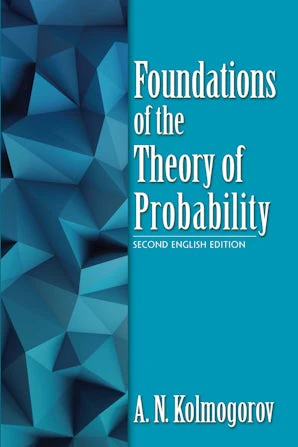
Foundations of the Theory of Probability
This famous little book was first published in German in 1933 and in Russian a few years later, setting forth the axiomatic foundations of modern probability theory and cementing the author's reputation as a leading authority in the field. The distinguished Russian mathematician A. N. Kolmogorov wrote this foundational text, and it remains important both to students beginning a serious study of the topic and to historians of modern mathematics.
Suitable as a text for advanced undergraduates and graduate students in mathematics, the treatment begins with an introduction to the elementary theory of probability and infinite probability fields. Subsequent chapters explore random variables, mathematical expectations, and conditional probabilities and mathematical expectations. The book concludes with a chapter on the law of large numbers, an Appendix on zero-or-one in the theory of probability, and detailed bibliographies.
Suitable as a text for advanced undergraduates and graduate students in mathematics, the treatment begins with an introduction to the elementary theory of probability and infinite probability fields. Subsequent chapters explore random variables, mathematical expectations, and conditional probabilities and mathematical expectations. The book concludes with a chapter on the law of large numbers, an Appendix on zero-or-one in the theory of probability, and detailed bibliographies.
Reprint of the Chelsea Publishing Company, New York, 1956 second edition.
Abstract Lebesgue Integral; Bayes Theorem; Borel fields; Probability function; graduate students; historical; infinite probability fields; law of large numbers; Markov chains Axiom of continuity; Tchebycheff inequality; The Law of Large Numbers$4.53
Original: $12.95
-65%Foundations of the Theory of Probability—
$12.95
$4.53Product Information
Product Information
Shipping & Returns
Shipping & Returns
Description
This famous little book was first published in German in 1933 and in Russian a few years later, setting forth the axiomatic foundations of modern probability theory and cementing the author's reputation as a leading authority in the field. The distinguished Russian mathematician A. N. Kolmogorov wrote this foundational text, and it remains important both to students beginning a serious study of the topic and to historians of modern mathematics.
Suitable as a text for advanced undergraduates and graduate students in mathematics, the treatment begins with an introduction to the elementary theory of probability and infinite probability fields. Subsequent chapters explore random variables, mathematical expectations, and conditional probabilities and mathematical expectations. The book concludes with a chapter on the law of large numbers, an Appendix on zero-or-one in the theory of probability, and detailed bibliographies.
Suitable as a text for advanced undergraduates and graduate students in mathematics, the treatment begins with an introduction to the elementary theory of probability and infinite probability fields. Subsequent chapters explore random variables, mathematical expectations, and conditional probabilities and mathematical expectations. The book concludes with a chapter on the law of large numbers, an Appendix on zero-or-one in the theory of probability, and detailed bibliographies.
Reprint of the Chelsea Publishing Company, New York, 1956 second edition.
Abstract Lebesgue Integral; Bayes Theorem; Borel fields; Probability function; graduate students; historical; infinite probability fields; law of large numbers; Markov chains Axiom of continuity; Tchebycheff inequality; The Law of Large Numbers