Probability Theory
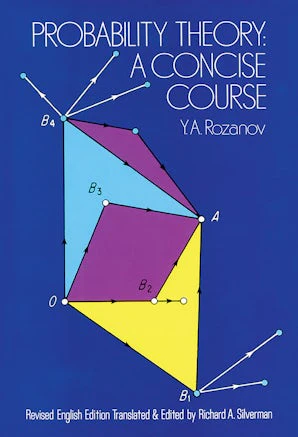
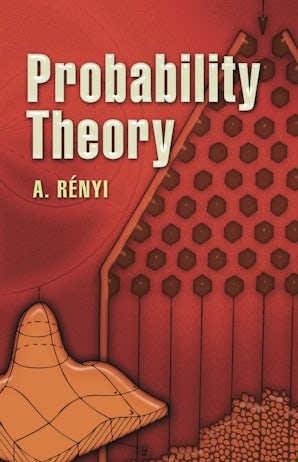
Based on the author's lectures at the University of Budapest, this text requires no preliminary knowledge of probability theory. Readers should, however, be familiar with other branches of mathematics, including a thorough understanding of the elements of the differential and integral calculus and the theory of real and complex functions. These well-chosen problems and exercises illustrate the algebras of events, discrete random variables, characteristic functions, and limit theorems. The text concludes with an extensive appendix that introduces information theory.
Bonus Editorial Feature
Alfred Renyi: The Happy Mathematician
Alfred Renyi (1921–1970) was one of the giants of twentieth-century mathematics who, during his relatively short life, made major contributions to combinatorics, graph theory, number theory, and other fields.
Reviewing Probability Theory and Foundations of Probability simultaneously for the Bulletin of the American Mathematical Society in 1973, Alberto R. Galmarino wrote:
"Both books complement each other well and have, as said before, little overlap. They represent nearly opposite approaches to the question of how the theory should be presented to beginners. Rényi excels in both approaches. Probability Theory is an imposing textbook. Foundations is a masterpiece."
In the Author's Own Words:
"If I feel unhappy, I do mathematics to become happy. If I am happy, I do mathematics to keep happy."
"Can the difficulty of an exam be measured by how many bits of information a student would need to pass it? This may not be so absurd in the encyclopedic subjects but in mathematics it doesn't make any sense since things follow from each other and, in principle, whoever knows the bases knows everything. All of the results of a mathematical theorem are in the axioms of mathematics in embryonic form, aren't they?" — Alfred Rényi
Original: $34.95
-65%$34.95
$12.23Product Information
Product Information
Shipping & Returns
Shipping & Returns
Description
Based on the author's lectures at the University of Budapest, this text requires no preliminary knowledge of probability theory. Readers should, however, be familiar with other branches of mathematics, including a thorough understanding of the elements of the differential and integral calculus and the theory of real and complex functions. These well-chosen problems and exercises illustrate the algebras of events, discrete random variables, characteristic functions, and limit theorems. The text concludes with an extensive appendix that introduces information theory.
Bonus Editorial Feature
Alfred Renyi: The Happy Mathematician
Alfred Renyi (1921–1970) was one of the giants of twentieth-century mathematics who, during his relatively short life, made major contributions to combinatorics, graph theory, number theory, and other fields.
Reviewing Probability Theory and Foundations of Probability simultaneously for the Bulletin of the American Mathematical Society in 1973, Alberto R. Galmarino wrote:
"Both books complement each other well and have, as said before, little overlap. They represent nearly opposite approaches to the question of how the theory should be presented to beginners. Rényi excels in both approaches. Probability Theory is an imposing textbook. Foundations is a masterpiece."
In the Author's Own Words:
"If I feel unhappy, I do mathematics to become happy. If I am happy, I do mathematics to keep happy."
"Can the difficulty of an exam be measured by how many bits of information a student would need to pass it? This may not be so absurd in the encyclopedic subjects but in mathematics it doesn't make any sense since things follow from each other and, in principle, whoever knows the bases knows everything. All of the results of a mathematical theorem are in the axioms of mathematics in embryonic form, aren't they?" — Alfred Rényi