🎉 Up to 70% Off Selected ItemsShop Sale
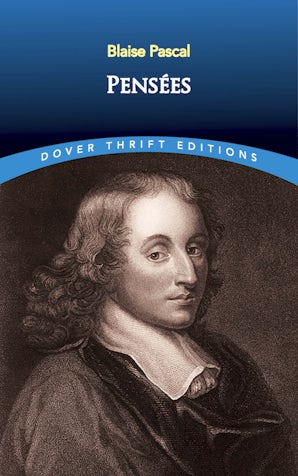
Pensées
"I know of no religious writer more pertinent to our time." — T. S. Eliot, Introduction to Pensées
"Men despise religion. They hate it and are afraid it may be true," declared Pascal in his Pensées. "The cure for this," he explained, "is first to show that religion is not contrary to reason, but worthy of reverence and respect. Next make it attractive, make good men wish it were true, and then show that it is."
Motivated by the 17th-century view of the supremacy of human reason, Pascal (1623-62) had intended to write an ambitious apologia for Christianity, in which he argued the inability of reason to address metaphysical problems. His untimely death prevented his completion of the work, but the fragments published posthumously in 1670 form a vital part of religious and philosophical literature. Essential reading for students of history, philosophy, and theology, the Pensées remain among the liveliest and most eloquent defenses of Christianity ever written.
"Men despise religion. They hate it and are afraid it may be true," declared Pascal in his Pensées. "The cure for this," he explained, "is first to show that religion is not contrary to reason, but worthy of reverence and respect. Next make it attractive, make good men wish it were true, and then show that it is."
Motivated by the 17th-century view of the supremacy of human reason, Pascal (1623-62) had intended to write an ambitious apologia for Christianity, in which he argued the inability of reason to address metaphysical problems. His untimely death prevented his completion of the work, but the fragments published posthumously in 1670 form a vital part of religious and philosophical literature. Essential reading for students of history, philosophy, and theology, the Pensées remain among the liveliest and most eloquent defenses of Christianity ever written.
Reprint of the E. P. Dutton & Co., Inc., New York, 1958 edition.
religion;philosophy;pascals wager;religious;christianity;religious writer;ambitious apologia;philosophical literature;religious literature;eloquent defenses;17th century philosophy;metaphysical problems;history;theology;religious conversion;nonfiction;french literature;french essays;profound insights;human condition;english translation;brilliant disorder;god;jesus christ;faith; Thoughts; fragments on theology and philosophy written; 17th-century philosopher; asceticism; Christian religion; Pascal's Wager; French mathematician; French physicist; French inventor: French writer; Catholic theologian; Rouen; study of fluids; concepts of pressure and vacuum; scientific method; calculating machines; mechanical calculator; projective geometry; probability theory; Jansenism; Lettres provincials; Jansenists; Jesuits$7.00
Pensées—
$7.00
Product Information
Product Information
Shipping & Returns
Shipping & Returns
Description
"I know of no religious writer more pertinent to our time." — T. S. Eliot, Introduction to Pensées
"Men despise religion. They hate it and are afraid it may be true," declared Pascal in his Pensées. "The cure for this," he explained, "is first to show that religion is not contrary to reason, but worthy of reverence and respect. Next make it attractive, make good men wish it were true, and then show that it is."
Motivated by the 17th-century view of the supremacy of human reason, Pascal (1623-62) had intended to write an ambitious apologia for Christianity, in which he argued the inability of reason to address metaphysical problems. His untimely death prevented his completion of the work, but the fragments published posthumously in 1670 form a vital part of religious and philosophical literature. Essential reading for students of history, philosophy, and theology, the Pensées remain among the liveliest and most eloquent defenses of Christianity ever written.
"Men despise religion. They hate it and are afraid it may be true," declared Pascal in his Pensées. "The cure for this," he explained, "is first to show that religion is not contrary to reason, but worthy of reverence and respect. Next make it attractive, make good men wish it were true, and then show that it is."
Motivated by the 17th-century view of the supremacy of human reason, Pascal (1623-62) had intended to write an ambitious apologia for Christianity, in which he argued the inability of reason to address metaphysical problems. His untimely death prevented his completion of the work, but the fragments published posthumously in 1670 form a vital part of religious and philosophical literature. Essential reading for students of history, philosophy, and theology, the Pensées remain among the liveliest and most eloquent defenses of Christianity ever written.
Reprint of the E. P. Dutton & Co., Inc., New York, 1958 edition.
religion;philosophy;pascals wager;religious;christianity;religious writer;ambitious apologia;philosophical literature;religious literature;eloquent defenses;17th century philosophy;metaphysical problems;history;theology;religious conversion;nonfiction;french literature;french essays;profound insights;human condition;english translation;brilliant disorder;god;jesus christ;faith; Thoughts; fragments on theology and philosophy written; 17th-century philosopher; asceticism; Christian religion; Pascal's Wager; French mathematician; French physicist; French inventor: French writer; Catholic theologian; Rouen; study of fluids; concepts of pressure and vacuum; scientific method; calculating machines; mechanical calculator; projective geometry; probability theory; Jansenism; Lettres provincials; Jansenists; Jesuits