🎉 Up to 70% Off Selected ItemsShop Sale
The Subjectivity of Scientists and the Bayesian Approach
"Press and Tanur argue that subjectivity has not only played a significant role in the advancement of science but that science will advance more rapidly if the modern methods of Bayesian statistical analysis replace some of the more classical twentieth-century methods." — SciTech Book News.
"An insightful work." ― Choice.
"Compilation of interesting popular problems … this book is fascinating." — Short Book Reviews, International Statistical Institute.
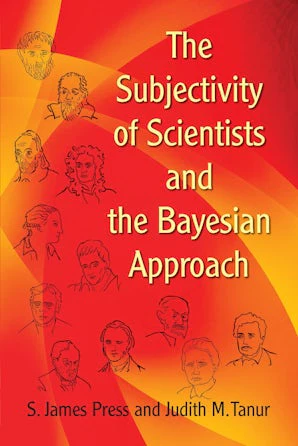
Subjectivity ― including intuition, hunches, and personal beliefs ― has played a key role in scientific discovery. This intriguing book illustrates subjective influences on scientific progress with historical accounts and biographical sketches of more than a dozen luminaries, including Aristotle, Galileo, Newton, Darwin, Pasteur, Freud, Einstein, Margaret Mead, and others. The treatment also offers a detailed examination of the modern Bayesian approach to data analysis, with references to the Bayesian theoretical and applied literature. Suitable for lay readers as well as science specialists, this survey will also appeal to historians of science and those interested in knowing more about the Bayesian approach.
"An insightful work." ― Choice.
"Compilation of interesting popular problems … this book is fascinating." — Short Book Reviews, International Statistical Institute.
Subjectivity ― including intuition, hunches, and personal beliefs ― has played a key role in scientific discovery. This intriguing book illustrates subjective influences on scientific progress with historical accounts and biographical sketches of more than a dozen luminaries, including Aristotle, Galileo, Newton, Darwin, Pasteur, Freud, Einstein, Margaret Mead, and others. The treatment also offers a detailed examination of the modern Bayesian approach to data analysis, with references to the Bayesian theoretical and applied literature. Suitable for lay readers as well as science specialists, this survey will also appeal to historians of science and those interested in knowing more about the Bayesian approach.
Reprint of the John Wiley and Sons, Inc., New York, 2001 edition.
nonfiction; bayesian analysis; scientists and the bayesian approach; mathematics; history & philosophy probability & statistics; statistical prediction; theoretical analysis; statistical models; bayesian inference; posterior probability; subjectivity; aristotle; galileo; newton; darwin; pasteur; freud; einstein; margaret mead; experiments; theoretical; phenomenon; history; tragic; science; physics, Statistics; Probability; Aristotle; Galileo; Newton; Einstein; Margaret Mead; Bayesian Statistics; Statistical Analysis; History of Science; Great Scientists; Modern Science; Subjectivity in Science; Pasteur$19.95
The Subjectivity of Scientists and the Bayesian Approach—
$19.95
Product Information
Product Information
Shipping & Returns
Shipping & Returns
Description
"Press and Tanur argue that subjectivity has not only played a significant role in the advancement of science but that science will advance more rapidly if the modern methods of Bayesian statistical analysis replace some of the more classical twentieth-century methods." — SciTech Book News.
"An insightful work." ― Choice.
"Compilation of interesting popular problems … this book is fascinating." — Short Book Reviews, International Statistical Institute.
Subjectivity ― including intuition, hunches, and personal beliefs ― has played a key role in scientific discovery. This intriguing book illustrates subjective influences on scientific progress with historical accounts and biographical sketches of more than a dozen luminaries, including Aristotle, Galileo, Newton, Darwin, Pasteur, Freud, Einstein, Margaret Mead, and others. The treatment also offers a detailed examination of the modern Bayesian approach to data analysis, with references to the Bayesian theoretical and applied literature. Suitable for lay readers as well as science specialists, this survey will also appeal to historians of science and those interested in knowing more about the Bayesian approach.
"An insightful work." ― Choice.
"Compilation of interesting popular problems … this book is fascinating." — Short Book Reviews, International Statistical Institute.
Subjectivity ― including intuition, hunches, and personal beliefs ― has played a key role in scientific discovery. This intriguing book illustrates subjective influences on scientific progress with historical accounts and biographical sketches of more than a dozen luminaries, including Aristotle, Galileo, Newton, Darwin, Pasteur, Freud, Einstein, Margaret Mead, and others. The treatment also offers a detailed examination of the modern Bayesian approach to data analysis, with references to the Bayesian theoretical and applied literature. Suitable for lay readers as well as science specialists, this survey will also appeal to historians of science and those interested in knowing more about the Bayesian approach.
Reprint of the John Wiley and Sons, Inc., New York, 2001 edition.
nonfiction; bayesian analysis; scientists and the bayesian approach; mathematics; history & philosophy probability & statistics; statistical prediction; theoretical analysis; statistical models; bayesian inference; posterior probability; subjectivity; aristotle; galileo; newton; darwin; pasteur; freud; einstein; margaret mead; experiments; theoretical; phenomenon; history; tragic; science; physics, Statistics; Probability; Aristotle; Galileo; Newton; Einstein; Margaret Mead; Bayesian Statistics; Statistical Analysis; History of Science; Great Scientists; Modern Science; Subjectivity in Science; Pasteur