🎉 Up to 70% Off Selected ItemsShop Sale
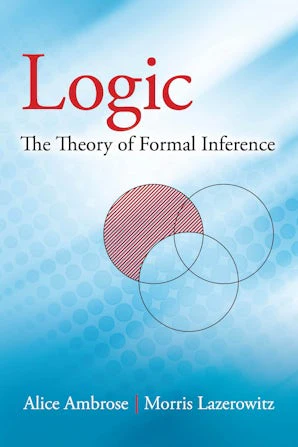
Logic: The Theory of Formal Inference
Geared toward college undergraduates new to the subject, this concise introduction to formal logic was written by Alice Ambrose and Morris Lazerowitz, a pair of noted scholars and prolific authors in this field. A preliminary section opens the subject under the heading of truth-functions. Two subsequent parts on quantification and classes, each subdivided into numerous brief specifics, complete the overview.
Suitable for students of philosophy as well as mathematics, the three-part treatment begins with the intuitive development of the standard theory of sentential connectives (called "operators"). The theory is further developed with the assistance of truth-tables and ultimately as a logistic system. Part II explores first-order quantification theory. In addition to examining most of the familiar laws that can be expressed by monadic formulas, the text addresses polyadic principles and the theories of identity and descriptions. Part III focuses on elementary concepts of classes, from class membership and class inclusion to the algebra of classes. Each part concludes with a series of exercises.
understanding logic;mathematics;math books;logic;theory of formal inference;philosophy;standard theory of sentential connectives;truth-tables;logistic system;first-order quantification theory;monadic formulas;polyadic principles;theories of identity;elementary concepts of classes;algebra of classes;complex;science and math;Logic; Formal Inference; Truth-Functions (Logic); Quantification (Logic); Classes (Logic)
Suitable for students of philosophy as well as mathematics, the three-part treatment begins with the intuitive development of the standard theory of sentential connectives (called "operators"). The theory is further developed with the assistance of truth-tables and ultimately as a logistic system. Part II explores first-order quantification theory. In addition to examining most of the familiar laws that can be expressed by monadic formulas, the text addresses polyadic principles and the theories of identity and descriptions. Part III focuses on elementary concepts of classes, from class membership and class inclusion to the algebra of classes. Each part concludes with a series of exercises.
Reprint of the Holt, Rinehart and Winston, New York, 1961 edition.
$12.95
Logic: The Theory of Formal Inference—
$12.95
Product Information
Product Information
Shipping & Returns
Shipping & Returns
Description
Geared toward college undergraduates new to the subject, this concise introduction to formal logic was written by Alice Ambrose and Morris Lazerowitz, a pair of noted scholars and prolific authors in this field. A preliminary section opens the subject under the heading of truth-functions. Two subsequent parts on quantification and classes, each subdivided into numerous brief specifics, complete the overview.
Suitable for students of philosophy as well as mathematics, the three-part treatment begins with the intuitive development of the standard theory of sentential connectives (called "operators"). The theory is further developed with the assistance of truth-tables and ultimately as a logistic system. Part II explores first-order quantification theory. In addition to examining most of the familiar laws that can be expressed by monadic formulas, the text addresses polyadic principles and the theories of identity and descriptions. Part III focuses on elementary concepts of classes, from class membership and class inclusion to the algebra of classes. Each part concludes with a series of exercises.
understanding logic;mathematics;math books;logic;theory of formal inference;philosophy;standard theory of sentential connectives;truth-tables;logistic system;first-order quantification theory;monadic formulas;polyadic principles;theories of identity;elementary concepts of classes;algebra of classes;complex;science and math;Logic; Formal Inference; Truth-Functions (Logic); Quantification (Logic); Classes (Logic)
Suitable for students of philosophy as well as mathematics, the three-part treatment begins with the intuitive development of the standard theory of sentential connectives (called "operators"). The theory is further developed with the assistance of truth-tables and ultimately as a logistic system. Part II explores first-order quantification theory. In addition to examining most of the familiar laws that can be expressed by monadic formulas, the text addresses polyadic principles and the theories of identity and descriptions. Part III focuses on elementary concepts of classes, from class membership and class inclusion to the algebra of classes. Each part concludes with a series of exercises.
Reprint of the Holt, Rinehart and Winston, New York, 1961 edition.