🎉 Up to 70% Off Selected ItemsShop Sale
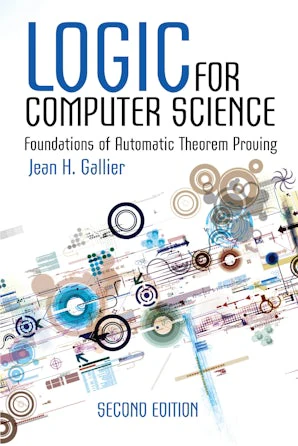
Logic for Computer Science
This advanced text for undergraduate and graduate students introduces mathematical logic with an emphasis on proof theory and procedures for algorithmic construction of formal proofs. The self-contained treatment is also useful for computer scientists and mathematically inclined readers interested in the formalization of proofs and basics of automatic theorem proving.
Topics include propositional logic and its resolution, first-order logic, Gentzen's cut elimination theorem and applications, and Gentzen's sharpened Hauptsatz and Herbrand's theorem. Additional subjects include resolution in first-order logic; SLD-resolution, logic programming, and the foundations of PROLOG; and many-sorted first-order logic. Numerous problems appear throughout the book, and two Appendixes provide practical background information.
Topics include propositional logic and its resolution, first-order logic, Gentzen's cut elimination theorem and applications, and Gentzen's sharpened Hauptsatz and Herbrand's theorem. Additional subjects include resolution in first-order logic; SLD-resolution, logic programming, and the foundations of PROLOG; and many-sorted first-order logic. Numerous problems appear throughout the book, and two Appendixes provide practical background information.
Reprint of the revised 2003 online work of the Harper & Row, New York, 1986 edition.
non-fiction;computer science;study of computers;foundations of automatic theorem;algorithms;logic for computer science;programming;logic;mathematical logic;proof theory;algorithmic construction of formal proofs;propositional logic and its resolution;first-order logic;gentzen's cut elimination theorem and applications;gentzen's sharpened hauptsatz and herbrand's theorem;resolution in first-order logic; sld-resolution;logic programming;foundations of prolog;mathematics;complex;Computer Science; Logic for computer science; Propositional Logic; First-Order Logic; Gentzen's Cut Elimination Theorem$32.95
Logic for Computer Science—
$32.95
Product Information
Product Information
Shipping & Returns
Shipping & Returns
Description
This advanced text for undergraduate and graduate students introduces mathematical logic with an emphasis on proof theory and procedures for algorithmic construction of formal proofs. The self-contained treatment is also useful for computer scientists and mathematically inclined readers interested in the formalization of proofs and basics of automatic theorem proving.
Topics include propositional logic and its resolution, first-order logic, Gentzen's cut elimination theorem and applications, and Gentzen's sharpened Hauptsatz and Herbrand's theorem. Additional subjects include resolution in first-order logic; SLD-resolution, logic programming, and the foundations of PROLOG; and many-sorted first-order logic. Numerous problems appear throughout the book, and two Appendixes provide practical background information.
Topics include propositional logic and its resolution, first-order logic, Gentzen's cut elimination theorem and applications, and Gentzen's sharpened Hauptsatz and Herbrand's theorem. Additional subjects include resolution in first-order logic; SLD-resolution, logic programming, and the foundations of PROLOG; and many-sorted first-order logic. Numerous problems appear throughout the book, and two Appendixes provide practical background information.
Reprint of the revised 2003 online work of the Harper & Row, New York, 1986 edition.
non-fiction;computer science;study of computers;foundations of automatic theorem;algorithms;logic for computer science;programming;logic;mathematical logic;proof theory;algorithmic construction of formal proofs;propositional logic and its resolution;first-order logic;gentzen's cut elimination theorem and applications;gentzen's sharpened hauptsatz and herbrand's theorem;resolution in first-order logic; sld-resolution;logic programming;foundations of prolog;mathematics;complex;Computer Science; Logic for computer science; Propositional Logic; First-Order Logic; Gentzen's Cut Elimination Theorem