🎉 Up to 70% Off Selected ItemsShop Sale
On Angular Momentum
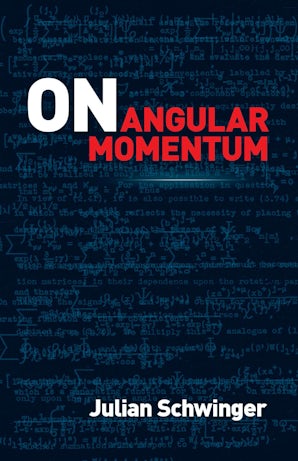
A concise treatment of angular momentum by an important American physicist, this major work was first published under the auspices of the United States Atomic Energy Commission in 1952 and is finally available to a general audience of students and professionals in the field. Advanced undergraduates and graduate students of physics will particularly benefit from its teachings.
One of the most prominent American physicists of the twentieth century, Julian Schwinger (1918–94) taught at Harvard, MIT, and UCLA, among other institutions. In addition to his many other awards, Schwinger, jointly with Richard Feynman and Shinichiro Tomonaga, received the Nobel Prize in Physics in 1965 for his work in quantum electrodynamics.
technical reports;computational texts;science textbooks;scientific information;quantum electrodynamics;diagrams;physics books;study of physics;american physicists;united states atomic energy commission;moments of inertia;the high rotational rates of neutron stars;the falling cat problem;complex;physics;theoretical
One of the most prominent American physicists of the twentieth century, Julian Schwinger (1918–94) taught at Harvard, MIT, and UCLA, among other institutions. In addition to his many other awards, Schwinger, jointly with Richard Feynman and Shinichiro Tomonaga, received the Nobel Prize in Physics in 1965 for his work in quantum electrodynamics.
First published for the United States Atomic Energy Commission by Technical Information Service, Oak Ridge, Tennessee, 1952.
$3.50
Original: $9.99
-65%On Angular Momentum—
$9.99
$3.50Product Information
Product Information
Shipping & Returns
Shipping & Returns
Description
A concise treatment of angular momentum by an important American physicist, this major work was first published under the auspices of the United States Atomic Energy Commission in 1952 and is finally available to a general audience of students and professionals in the field. Advanced undergraduates and graduate students of physics will particularly benefit from its teachings.
One of the most prominent American physicists of the twentieth century, Julian Schwinger (1918–94) taught at Harvard, MIT, and UCLA, among other institutions. In addition to his many other awards, Schwinger, jointly with Richard Feynman and Shinichiro Tomonaga, received the Nobel Prize in Physics in 1965 for his work in quantum electrodynamics.
technical reports;computational texts;science textbooks;scientific information;quantum electrodynamics;diagrams;physics books;study of physics;american physicists;united states atomic energy commission;moments of inertia;the high rotational rates of neutron stars;the falling cat problem;complex;physics;theoretical
One of the most prominent American physicists of the twentieth century, Julian Schwinger (1918–94) taught at Harvard, MIT, and UCLA, among other institutions. In addition to his many other awards, Schwinger, jointly with Richard Feynman and Shinichiro Tomonaga, received the Nobel Prize in Physics in 1965 for his work in quantum electrodynamics.
First published for the United States Atomic Energy Commission by Technical Information Service, Oak Ridge, Tennessee, 1952.