🎉 Up to 70% Off Selected ItemsShop Sale
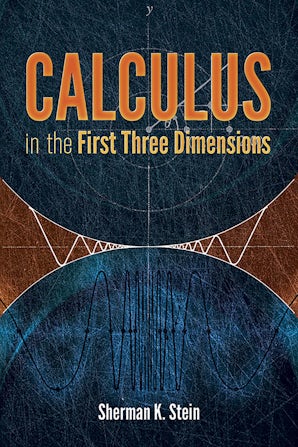
Calculus in the First Three Dimensions
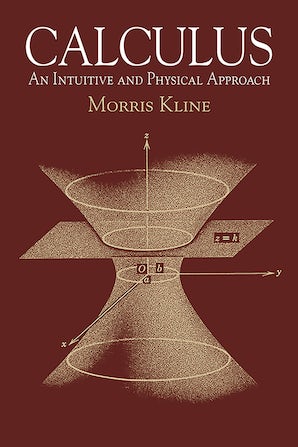
This introduction to calculus is designed for beginning college undergraduates majoring in mathematics as well as undergraduates pursuing other areas of science and engineering for whom calculus will be a vital tool.
The three-part treatment begins by exploring the core of the calculus, concentrating on three basic ideas: the definite integral, the derivative, and the fundamental theorem of calculus. Part Two takes up topics such as the maximum and minimum of a function, Taylor's series, partial derivatives, differentiation of vectors, and Green's theorem in the plane. Part Three, which contains no further mathematical development, applies the techniques developed earlier to significant problems in the natural, social, and physical sciences. Appendixes supplement the treatment, offering helpful information on the rudiments of analytic geometry, real numbers, and functions. Numerous examples and exercises appear throughout the text, and solutions to the problems are available as free downloads from the Dover website.
The three-part treatment begins by exploring the core of the calculus, concentrating on three basic ideas: the definite integral, the derivative, and the fundamental theorem of calculus. Part Two takes up topics such as the maximum and minimum of a function, Taylor's series, partial derivatives, differentiation of vectors, and Green's theorem in the plane. Part Three, which contains no further mathematical development, applies the techniques developed earlier to significant problems in the natural, social, and physical sciences. Appendixes supplement the treatment, offering helpful information on the rudiments of analytic geometry, real numbers, and functions. Numerous examples and exercises appear throughout the text, and solutions to the problems are available as free downloads from the Dover website.
Reprint of the McGraw-Hill, New York, 1967 edition.
A solutions manual to accompany this text is available for free download. Click here to download PDF version now.
introduction to calculus;understanding calculus;mathematics majors;definite integrals;the fundamental theorem of calculus;maximum and minimum of a function;taylors series;greens theorem;mathematics;calculus;fundamental theorems;partial derivatives;mathematical development;solving calculus problems;physical sciences;differentiation of vectors;complex;science and math;students and teachers;rudiments of analytic geometry$44.95
Calculus in the First Three Dimensions—
$44.95
Product Information
Product Information
Shipping & Returns
Shipping & Returns
Description
This introduction to calculus is designed for beginning college undergraduates majoring in mathematics as well as undergraduates pursuing other areas of science and engineering for whom calculus will be a vital tool.
The three-part treatment begins by exploring the core of the calculus, concentrating on three basic ideas: the definite integral, the derivative, and the fundamental theorem of calculus. Part Two takes up topics such as the maximum and minimum of a function, Taylor's series, partial derivatives, differentiation of vectors, and Green's theorem in the plane. Part Three, which contains no further mathematical development, applies the techniques developed earlier to significant problems in the natural, social, and physical sciences. Appendixes supplement the treatment, offering helpful information on the rudiments of analytic geometry, real numbers, and functions. Numerous examples and exercises appear throughout the text, and solutions to the problems are available as free downloads from the Dover website.
The three-part treatment begins by exploring the core of the calculus, concentrating on three basic ideas: the definite integral, the derivative, and the fundamental theorem of calculus. Part Two takes up topics such as the maximum and minimum of a function, Taylor's series, partial derivatives, differentiation of vectors, and Green's theorem in the plane. Part Three, which contains no further mathematical development, applies the techniques developed earlier to significant problems in the natural, social, and physical sciences. Appendixes supplement the treatment, offering helpful information on the rudiments of analytic geometry, real numbers, and functions. Numerous examples and exercises appear throughout the text, and solutions to the problems are available as free downloads from the Dover website.
Reprint of the McGraw-Hill, New York, 1967 edition.
A solutions manual to accompany this text is available for free download. Click here to download PDF version now.
introduction to calculus;understanding calculus;mathematics majors;definite integrals;the fundamental theorem of calculus;maximum and minimum of a function;taylors series;greens theorem;mathematics;calculus;fundamental theorems;partial derivatives;mathematical development;solving calculus problems;physical sciences;differentiation of vectors;complex;science and math;students and teachers;rudiments of analytic geometry