🎉 Up to 70% Off Selected ItemsShop Sale
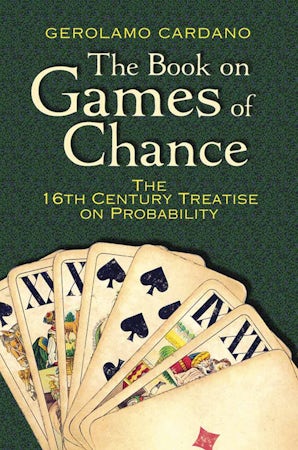
The Book on Games of Chance
Mathematics was only one area of interest for Gerolamo Cardano ― the sixteenth-century astrologer, philosopher, and physician was also a prolific author and inveterate gambler. Gambling led Cardano to the study of probability, and he was the first writer to recognize that random events are governed by mathematical laws.
Published posthumously in 1663, Cardano's Liber de ludo aleae (Book on Games of Chance) is often considered the major starting point of the study of mathematical probability. The Italian scholar formulated some of the field's basic ideas more than a century before the better-known correspondence of Pascal and Fermat. Although his book had no direct influence on other early thinkers about probability, it remains an important antecedent to later expressions of the science's tenets.
study of probability;random events governed by mathematical laws;mathematical probability;16th century scholarship;aristotle on gambling;dice;cards;fundamental principle of gambling;game theory;probability;mathematical probabilities;games of chance;mathematics in gaming;gambling probabilities;random events in gaming;number probabilities;poker and math;the mathematics of poker;antecedents of gaming;history of mathematic probabilities;pascal and fermat;gambling;mathematics
Published posthumously in 1663, Cardano's Liber de ludo aleae (Book on Games of Chance) is often considered the major starting point of the study of mathematical probability. The Italian scholar formulated some of the field's basic ideas more than a century before the better-known correspondence of Pascal and Fermat. Although his book had no direct influence on other early thinkers about probability, it remains an important antecedent to later expressions of the science's tenets.
Reprint of the Holt, Rinehart and Winston, New York, 1961 edition.
$3.13
Original: $8.95
-65%The Book on Games of Chance—
$8.95
$3.13Product Information
Product Information
Shipping & Returns
Shipping & Returns
Description
Mathematics was only one area of interest for Gerolamo Cardano ― the sixteenth-century astrologer, philosopher, and physician was also a prolific author and inveterate gambler. Gambling led Cardano to the study of probability, and he was the first writer to recognize that random events are governed by mathematical laws.
Published posthumously in 1663, Cardano's Liber de ludo aleae (Book on Games of Chance) is often considered the major starting point of the study of mathematical probability. The Italian scholar formulated some of the field's basic ideas more than a century before the better-known correspondence of Pascal and Fermat. Although his book had no direct influence on other early thinkers about probability, it remains an important antecedent to later expressions of the science's tenets.
study of probability;random events governed by mathematical laws;mathematical probability;16th century scholarship;aristotle on gambling;dice;cards;fundamental principle of gambling;game theory;probability;mathematical probabilities;games of chance;mathematics in gaming;gambling probabilities;random events in gaming;number probabilities;poker and math;the mathematics of poker;antecedents of gaming;history of mathematic probabilities;pascal and fermat;gambling;mathematics
Published posthumously in 1663, Cardano's Liber de ludo aleae (Book on Games of Chance) is often considered the major starting point of the study of mathematical probability. The Italian scholar formulated some of the field's basic ideas more than a century before the better-known correspondence of Pascal and Fermat. Although his book had no direct influence on other early thinkers about probability, it remains an important antecedent to later expressions of the science's tenets.
Reprint of the Holt, Rinehart and Winston, New York, 1961 edition.