🎉 Up to 70% Off Selected ItemsShop Sale
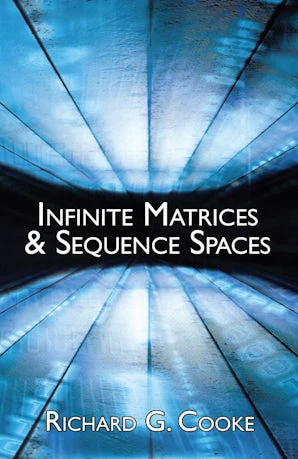
Infinite Matrices and Sequence Spaces
This clear and correct summation of basic results from a specialized field focuses on the behavior of infinite matrices in general, rather than on properties of special matrices. Three introductory chapters guide students to the manipulation of infinite matrices, covering definitions and preliminary ideas, reciprocals of infinite matrices, and linear equations involving infinite matrices.
From the fourth chapter onward, the author treats the application of infinite matrices to the summability of divergent sequences and series from various points of view. Topics include consistency, mutual consistency, and absolute equivalence; the core of a sequence; the inefficiency and the efficiency problems for infinite matrices; Hilbert vector space and Hilbert matrices; and projective and distance convergence and limit in sequence spaces. Each chapter concludes with examples — nearly 200 in all.
summation;basic results;specialized field;special matrices;preliminary ideas;reciprocals of infinite matrices;linear equations;divergent sequences;consistency;mutual consistency;absolute equivalence;sequence core;hilbert vector;mathematics;advanced mathematics;math reference;science;infinite matrices;sequence space;self study;reference;applied mathematics;science and math;experiments;school;students and teachers
From the fourth chapter onward, the author treats the application of infinite matrices to the summability of divergent sequences and series from various points of view. Topics include consistency, mutual consistency, and absolute equivalence; the core of a sequence; the inefficiency and the efficiency problems for infinite matrices; Hilbert vector space and Hilbert matrices; and projective and distance convergence and limit in sequence spaces. Each chapter concludes with examples — nearly 200 in all.
Reprint of the Dover 1995 edition, originally published by Macmillan and Company, Ltd., London, 1950.
First edition: London: Macmillan, 1950
Edition we are reprinting: Dover, 1966
No changes or new material
First edition: London: Macmillan, 1950
Edition we are reprinting: Dover, 1966
No changes or new material
$22.95
Infinite Matrices and Sequence Spaces—
$22.95
Product Information
Product Information
Shipping & Returns
Shipping & Returns
Description
This clear and correct summation of basic results from a specialized field focuses on the behavior of infinite matrices in general, rather than on properties of special matrices. Three introductory chapters guide students to the manipulation of infinite matrices, covering definitions and preliminary ideas, reciprocals of infinite matrices, and linear equations involving infinite matrices.
From the fourth chapter onward, the author treats the application of infinite matrices to the summability of divergent sequences and series from various points of view. Topics include consistency, mutual consistency, and absolute equivalence; the core of a sequence; the inefficiency and the efficiency problems for infinite matrices; Hilbert vector space and Hilbert matrices; and projective and distance convergence and limit in sequence spaces. Each chapter concludes with examples — nearly 200 in all.
summation;basic results;specialized field;special matrices;preliminary ideas;reciprocals of infinite matrices;linear equations;divergent sequences;consistency;mutual consistency;absolute equivalence;sequence core;hilbert vector;mathematics;advanced mathematics;math reference;science;infinite matrices;sequence space;self study;reference;applied mathematics;science and math;experiments;school;students and teachers
From the fourth chapter onward, the author treats the application of infinite matrices to the summability of divergent sequences and series from various points of view. Topics include consistency, mutual consistency, and absolute equivalence; the core of a sequence; the inefficiency and the efficiency problems for infinite matrices; Hilbert vector space and Hilbert matrices; and projective and distance convergence and limit in sequence spaces. Each chapter concludes with examples — nearly 200 in all.
Reprint of the Dover 1995 edition, originally published by Macmillan and Company, Ltd., London, 1950.
First edition: London: Macmillan, 1950
Edition we are reprinting: Dover, 1966
No changes or new material
First edition: London: Macmillan, 1950
Edition we are reprinting: Dover, 1966
No changes or new material