🎉 Up to 70% Off Selected ItemsShop Sale
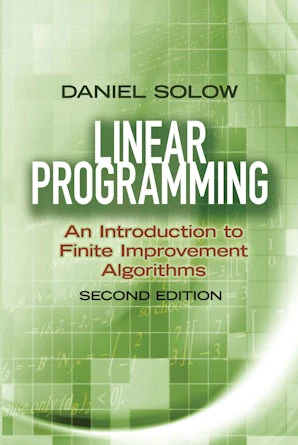
Linear Programming: An Introduction to Finite Improvement Algorithms
Suitable for undergraduate students of mathematics and graduate students of operations research and engineering, this text covers the basic theory and computation for a first course in linear programming. In addition to substantial material on mathematical proof techniques and sophisticated computation methods, the treatment features numerous examples and exercises.
An introductory chapter offers a systematic and organized approach to problem formulation. Subsequent chapters explore geometric motivation, proof techniques, linear algebra and algebraic steps related to the simplex algorithm, standard phase 1 problems, and computational implementation of the simplex algorithm. Additional topics include duality theory, issues of sensitivity and parametric analysis, techniques for handling bound constraints, and network flow problems. Helpful appendixes conclude the text, including a new addition that explains how to use Excel to solve linear programming problems.
An introductory chapter offers a systematic and organized approach to problem formulation. Subsequent chapters explore geometric motivation, proof techniques, linear algebra and algebraic steps related to the simplex algorithm, standard phase 1 problems, and computational implementation of the simplex algorithm. Additional topics include duality theory, issues of sensitivity and parametric analysis, techniques for handling bound constraints, and network flow problems. Helpful appendixes conclude the text, including a new addition that explains how to use Excel to solve linear programming problems.
Reprint of the North-Holland, New York, 1984 edition. Includes a new appendix.
math theory;programming;operations research;engineering;basic theory;undergraduate students;engaging;career;school;scientists;theoretical;science and math;algebra;geometric motivation;grad school;algebraic steps;problem formulation;computational implementation;parametric analysis;bound constraints;proof techniques;duality theory;mathematical proof techniques;finite improvement algorithms;sophisticated computation methods$24.95
Linear Programming: An Introduction to Finite Improvement Algorithms—
$24.95
Product Information
Product Information
Shipping & Returns
Shipping & Returns
Description
Suitable for undergraduate students of mathematics and graduate students of operations research and engineering, this text covers the basic theory and computation for a first course in linear programming. In addition to substantial material on mathematical proof techniques and sophisticated computation methods, the treatment features numerous examples and exercises.
An introductory chapter offers a systematic and organized approach to problem formulation. Subsequent chapters explore geometric motivation, proof techniques, linear algebra and algebraic steps related to the simplex algorithm, standard phase 1 problems, and computational implementation of the simplex algorithm. Additional topics include duality theory, issues of sensitivity and parametric analysis, techniques for handling bound constraints, and network flow problems. Helpful appendixes conclude the text, including a new addition that explains how to use Excel to solve linear programming problems.
An introductory chapter offers a systematic and organized approach to problem formulation. Subsequent chapters explore geometric motivation, proof techniques, linear algebra and algebraic steps related to the simplex algorithm, standard phase 1 problems, and computational implementation of the simplex algorithm. Additional topics include duality theory, issues of sensitivity and parametric analysis, techniques for handling bound constraints, and network flow problems. Helpful appendixes conclude the text, including a new addition that explains how to use Excel to solve linear programming problems.
Reprint of the North-Holland, New York, 1984 edition. Includes a new appendix.
math theory;programming;operations research;engineering;basic theory;undergraduate students;engaging;career;school;scientists;theoretical;science and math;algebra;geometric motivation;grad school;algebraic steps;problem formulation;computational implementation;parametric analysis;bound constraints;proof techniques;duality theory;mathematical proof techniques;finite improvement algorithms;sophisticated computation methods