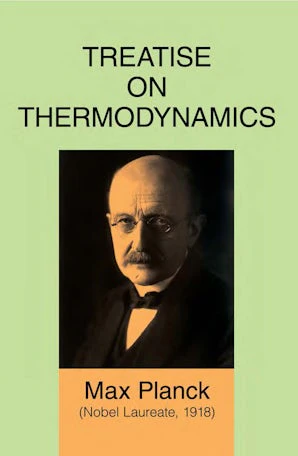
Treatise on Thermodynamics
Written by the founder of quantum theory, a Nobel Prize winner, this classic volume is still recognized as among the best introductions to thermodynamics. It is a model of conciseness and logic, ideally suited to the needs of both students and research workers in physics and chemistry.
Based on Planck's original papers, the book offers a uniform point of view for the entire field. Rejecting the earlier approaches of Helmholtz and Maxwell, Planck makes no assumptions regarding the nature of heat, but begins with only a few empirical facts from which he deduces new physical and chemical laws. He considers fundamental facts and definitions (temperature, molecular weight, quantity of heat), the first and second fundamental principles of thermodynamics (applications to homogeneous and non-homogeneous systems, proof, general deductions), and applications to special states of equilibrium (homogeneous systems, systems in various states of aggregation, system of any number of independent constituents, gaseous systems, dilute solutions, absolute value of the entropy, Nernst’s theorem). Throughout the book numerous examples are worked.
Reprint of Alexander Ogg's authorized translation, seventh 1922 German edition.
Original: $16.95
-65%$16.95
$5.93Product Information
Product Information
Shipping & Returns
Shipping & Returns
Description
Written by the founder of quantum theory, a Nobel Prize winner, this classic volume is still recognized as among the best introductions to thermodynamics. It is a model of conciseness and logic, ideally suited to the needs of both students and research workers in physics and chemistry.
Based on Planck's original papers, the book offers a uniform point of view for the entire field. Rejecting the earlier approaches of Helmholtz and Maxwell, Planck makes no assumptions regarding the nature of heat, but begins with only a few empirical facts from which he deduces new physical and chemical laws. He considers fundamental facts and definitions (temperature, molecular weight, quantity of heat), the first and second fundamental principles of thermodynamics (applications to homogeneous and non-homogeneous systems, proof, general deductions), and applications to special states of equilibrium (homogeneous systems, systems in various states of aggregation, system of any number of independent constituents, gaseous systems, dilute solutions, absolute value of the entropy, Nernst’s theorem). Throughout the book numerous examples are worked.
Reprint of Alexander Ogg's authorized translation, seventh 1922 German edition.