Theory of Wing Sections
"Most useful in working with wing sections and methods for using section data to predict wing characteristics . . . much detailed geometric and aerodynamic data." — Mechanical Engineering
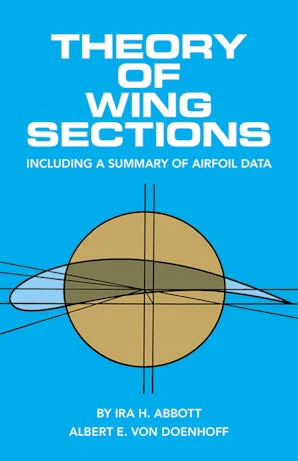
The first edition of this work has been corrected and republished in answer to the continuing demand for a concise compilation of the subsonic aerodynamics characteristics of modern NASA wing sections together with a description of their geometry and associated theory. These wing sections, or their derivatives, continue to be the ones most commonly used for airplanes designed for both subsonic and supersonic speeds, and for helicopter rotor blades, propeller blades, and high performance fans.
Intended to be primarily a reference work for engineers and students, the book devotes over 300 pages to theoretical and experimental considerations. The theoretical treatment progresses from elementary considerations to methods used for the design of NACA low-drag airfoils. Methods and data are presented for using wingsection data to predict wing characteristics, and judiciously selected plots and cross-plots of experimental data are presented for readily useful correlation of certain simplifying assumptions made in the analyses. The chapters on theory of thin wings and airfoils are particularly valuable, as is the complete summary of the NACA's experimental observations and system of constructing families of airfoils. Mathematics has been kept to a minimum, but it is assumed that the reader has a knowledge of differential and integral calculus, and elementary mechanics.
The appendix of over 350 pages contains these tables: Basic Thickness Forms, Mean Lines, Airfoil Ordinates, and Aerodynamic Characteristics of Wing Sections.
Original: $44.99
-65%$44.99
$15.75Product Information
Product Information
Shipping & Returns
Shipping & Returns
Description
"Most useful in working with wing sections and methods for using section data to predict wing characteristics . . . much detailed geometric and aerodynamic data." — Mechanical Engineering
The first edition of this work has been corrected and republished in answer to the continuing demand for a concise compilation of the subsonic aerodynamics characteristics of modern NASA wing sections together with a description of their geometry and associated theory. These wing sections, or their derivatives, continue to be the ones most commonly used for airplanes designed for both subsonic and supersonic speeds, and for helicopter rotor blades, propeller blades, and high performance fans.
Intended to be primarily a reference work for engineers and students, the book devotes over 300 pages to theoretical and experimental considerations. The theoretical treatment progresses from elementary considerations to methods used for the design of NACA low-drag airfoils. Methods and data are presented for using wingsection data to predict wing characteristics, and judiciously selected plots and cross-plots of experimental data are presented for readily useful correlation of certain simplifying assumptions made in the analyses. The chapters on theory of thin wings and airfoils are particularly valuable, as is the complete summary of the NACA's experimental observations and system of constructing families of airfoils. Mathematics has been kept to a minimum, but it is assumed that the reader has a knowledge of differential and integral calculus, and elementary mechanics.
The appendix of over 350 pages contains these tables: Basic Thickness Forms, Mean Lines, Airfoil Ordinates, and Aerodynamic Characteristics of Wing Sections.