🎉 Up to 70% Off Selected ItemsShop Sale
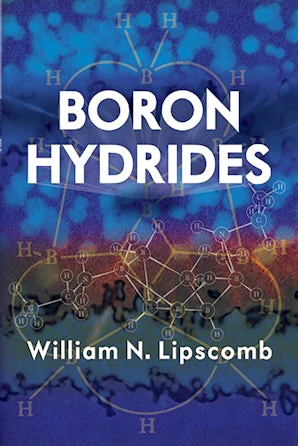
Boron Hydrides
In this classic monograph, Nobel Prize–winning chemist William N. Lipscomb elucidates his area of expertise: the general structural principles and reactions of boron hydrides and related compounds. Lipscomb's work appeared only a decade after the structures of boron hydrides were first elucidated and their chemistry formulated into a widely applicable framework. His observations led to a major reconsideration of how atoms bond to form stable molecules.
A concise treatment of the many separate parts of the structural theory and its relation to chemistry, this volume begins with an overview of boron hydrides and related structures, progressing to three-center bonds and their applications, molecular orbitals, nuclear magnetic resonance studies of boron hydrides and related compounds, and reactions of the boron hydrides. More than 120 diagrams and figures illustrate a variety of structures.
A concise treatment of the many separate parts of the structural theory and its relation to chemistry, this volume begins with an overview of boron hydrides and related structures, progressing to three-center bonds and their applications, molecular orbitals, nuclear magnetic resonance studies of boron hydrides and related compounds, and reactions of the boron hydrides. More than 120 diagrams and figures illustrate a variety of structures.
Reprint of the W. A. Benjamin, Inc., New York, 1963 edition.
educational; study guide; chemist; chemistry; boron hydrides; principles of boron hydrides; reactions of boron hydrides; structural theory; three center bonds; molecular orbitals; nuclear magnetic resonance; atoms; molecules; stable molecules; geometry; students and teachers$6.98
Original: $19.95
-65%Boron Hydrides—
$19.95
$6.98Product Information
Product Information
Shipping & Returns
Shipping & Returns
Description
In this classic monograph, Nobel Prize–winning chemist William N. Lipscomb elucidates his area of expertise: the general structural principles and reactions of boron hydrides and related compounds. Lipscomb's work appeared only a decade after the structures of boron hydrides were first elucidated and their chemistry formulated into a widely applicable framework. His observations led to a major reconsideration of how atoms bond to form stable molecules.
A concise treatment of the many separate parts of the structural theory and its relation to chemistry, this volume begins with an overview of boron hydrides and related structures, progressing to three-center bonds and their applications, molecular orbitals, nuclear magnetic resonance studies of boron hydrides and related compounds, and reactions of the boron hydrides. More than 120 diagrams and figures illustrate a variety of structures.
A concise treatment of the many separate parts of the structural theory and its relation to chemistry, this volume begins with an overview of boron hydrides and related structures, progressing to three-center bonds and their applications, molecular orbitals, nuclear magnetic resonance studies of boron hydrides and related compounds, and reactions of the boron hydrides. More than 120 diagrams and figures illustrate a variety of structures.
Reprint of the W. A. Benjamin, Inc., New York, 1963 edition.
educational; study guide; chemist; chemistry; boron hydrides; principles of boron hydrides; reactions of boron hydrides; structural theory; three center bonds; molecular orbitals; nuclear magnetic resonance; atoms; molecules; stable molecules; geometry; students and teachers