🎉 Up to 70% Off Selected ItemsShop Sale
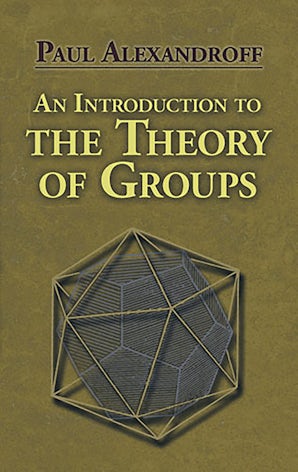
An Introduction to the Theory of Groups
This introductory exposition of group theory by an eminent Russian mathematician is particularly suited to undergraduates, developing material of fundamental importance in a clear and rigorous fashion. The treatment is also useful as a review for more advanced students with some background in group theory.
Beginning with introductory examples of the group concept, the text advances to considerations of groups of permutations, isomorphism, cyclic subgroups, simple groups of movements, invariant subgroups, and partitioning of groups. An appendix provides elementary concepts from set theory. A wealth of simple examples, primarily geometrical, illustrate the primary concepts. Exercises at the end of each chapter provide additional reinforcement.
Beginning with introductory examples of the group concept, the text advances to considerations of groups of permutations, isomorphism, cyclic subgroups, simple groups of movements, invariant subgroups, and partitioning of groups. An appendix provides elementary concepts from set theory. A wealth of simple examples, primarily geometrical, illustrate the primary concepts. Exercises at the end of each chapter provide additional reinforcement.
Reprint of the Hafner Publishing Co., New York, 1959 edition.
math; mathematics; mathematician; group; group theory; introduction to group theory; statistics; undergraduate study; student guide; study guide; chapter tests; quiz; science and math; electromagnetism; books with equations; Group Theory; Groups in Mathematics; Russian Mathematics; Paul Alexandroff$4.18
Original: $11.95
-65%An Introduction to the Theory of Groups—
$11.95
$4.18Product Information
Product Information
Shipping & Returns
Shipping & Returns
Description
This introductory exposition of group theory by an eminent Russian mathematician is particularly suited to undergraduates, developing material of fundamental importance in a clear and rigorous fashion. The treatment is also useful as a review for more advanced students with some background in group theory.
Beginning with introductory examples of the group concept, the text advances to considerations of groups of permutations, isomorphism, cyclic subgroups, simple groups of movements, invariant subgroups, and partitioning of groups. An appendix provides elementary concepts from set theory. A wealth of simple examples, primarily geometrical, illustrate the primary concepts. Exercises at the end of each chapter provide additional reinforcement.
Beginning with introductory examples of the group concept, the text advances to considerations of groups of permutations, isomorphism, cyclic subgroups, simple groups of movements, invariant subgroups, and partitioning of groups. An appendix provides elementary concepts from set theory. A wealth of simple examples, primarily geometrical, illustrate the primary concepts. Exercises at the end of each chapter provide additional reinforcement.
Reprint of the Hafner Publishing Co., New York, 1959 edition.
math; mathematics; mathematician; group; group theory; introduction to group theory; statistics; undergraduate study; student guide; study guide; chapter tests; quiz; science and math; electromagnetism; books with equations; Group Theory; Groups in Mathematics; Russian Mathematics; Paul Alexandroff