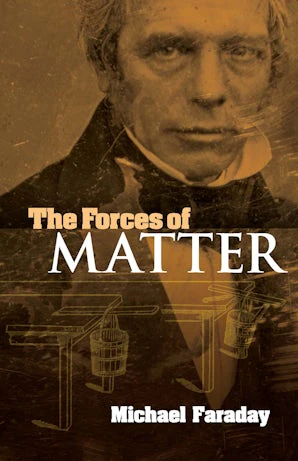
The Forces of Matter
One of the world's greatest experimental philosophers and popularizers of science, Faraday conducted the experiments that made electricity viable for technological use. In these six lectures, he offers a captivating introduction to concepts related to some of his most important discoveries. Topics include gravitation, cohesion, chemical affinity, heat, magnetism, and electricity.
Bonus Editorial Feature
Michael Faraday: An Electric Personality
A major figure in nineteenth-century science, Michael Faraday (1791–1867) made immense contributions to the study of electricity and magnetism, discovering the laws of electromagnetic induction and electrolysis. His experiments are the foundation of subsequent electromagnetic technology. He also had a sense of humor. When the Prime Minister of England William Gladstone asked Faraday what the usefulness of electricity would be, Faraday famously replied, "Why, Sir, there is every possibility that you will soon be able to tax it!" In addition to being a great experimenter, Faraday had the gift of exposition for a popular audience, as seen in the books which Dover has reprinted, The Forces of Matter (2010), Experimental Researches in Electricity (2004), and perhaps his most famous single book for the general reader, The Chemical History of a Candle (2003).
It is reliably reported that Einstein had a photograph of Faraday on the wall of his study alongside portraits of Isaac Newton and James Clerk Maxwell.
In the Author's Own Words:
"The world little knows how many of the thoughts and theories which have passed through the mind of a scientific investigator have been crushed in silence and secrecy by his own severe criticism and adverse examination: that in the most successful instances not a tenth of the suggestions, the hopes, the wishes, the preliminary conclusions have been realized." — Michael Faraday
Original: $4.87
-65%$4.87
$1.70Product Information
Product Information
Shipping & Returns
Shipping & Returns
Description
One of the world's greatest experimental philosophers and popularizers of science, Faraday conducted the experiments that made electricity viable for technological use. In these six lectures, he offers a captivating introduction to concepts related to some of his most important discoveries. Topics include gravitation, cohesion, chemical affinity, heat, magnetism, and electricity.
Bonus Editorial Feature
Michael Faraday: An Electric Personality
A major figure in nineteenth-century science, Michael Faraday (1791–1867) made immense contributions to the study of electricity and magnetism, discovering the laws of electromagnetic induction and electrolysis. His experiments are the foundation of subsequent electromagnetic technology. He also had a sense of humor. When the Prime Minister of England William Gladstone asked Faraday what the usefulness of electricity would be, Faraday famously replied, "Why, Sir, there is every possibility that you will soon be able to tax it!" In addition to being a great experimenter, Faraday had the gift of exposition for a popular audience, as seen in the books which Dover has reprinted, The Forces of Matter (2010), Experimental Researches in Electricity (2004), and perhaps his most famous single book for the general reader, The Chemical History of a Candle (2003).
It is reliably reported that Einstein had a photograph of Faraday on the wall of his study alongside portraits of Isaac Newton and James Clerk Maxwell.
In the Author's Own Words:
"The world little knows how many of the thoughts and theories which have passed through the mind of a scientific investigator have been crushed in silence and secrecy by his own severe criticism and adverse examination: that in the most successful instances not a tenth of the suggestions, the hopes, the wishes, the preliminary conclusions have been realized." — Michael Faraday