🎉 Up to 70% Off Selected ItemsShop Sale
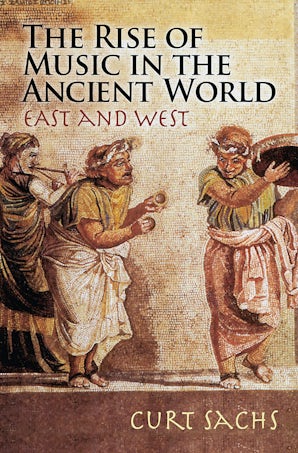
The Rise of Music in the Ancient World
In this groundbreaking, all-encompassing work, an eminent musicologist explores the evolution of music. It ranges from the ecstatic singing and Shaman songs of early civilizations to the development of more structured styles in Egypt, East Asia, India, Greece, Rome, the Middle East, and Europe. Eight plates of illustrations depict players and orchestras from China, Korea, Burma, India, and Egypt.
A survey of music in early societies leads to examinations of comparative musicology and its methods, melodic styles, rhythm and instrumental music, and polyphony. Advancing to the Western Orient and Eastern Asia, the author discusses musical systems in general, along with the concepts of scales, melody and rhythm, and notation. Subsequent chapters explore India's Vedic chants and ragas, the early modes of Greece and Rome, and the influence of the music of Islam. The book concludes with a look at the puzzle of medieval tonality and the conflict between European vocal and instrumental styles.
A survey of music in early societies leads to examinations of comparative musicology and its methods, melodic styles, rhythm and instrumental music, and polyphony. Advancing to the Western Orient and Eastern Asia, the author discusses musical systems in general, along with the concepts of scales, melody and rhythm, and notation. Subsequent chapters explore India's Vedic chants and ragas, the early modes of Greece and Rome, and the influence of the music of Islam. The book concludes with a look at the puzzle of medieval tonality and the conflict between European vocal and instrumental styles.
Reprint of the W. W. Norton & Company, Inc., New York, 1943 edition.
history of music; ancient music; Dover; Egyptian music; Roman music$24.95
The Rise of Music in the Ancient World—
$24.95
Product Information
Product Information
Shipping & Returns
Shipping & Returns
Description
In this groundbreaking, all-encompassing work, an eminent musicologist explores the evolution of music. It ranges from the ecstatic singing and Shaman songs of early civilizations to the development of more structured styles in Egypt, East Asia, India, Greece, Rome, the Middle East, and Europe. Eight plates of illustrations depict players and orchestras from China, Korea, Burma, India, and Egypt.
A survey of music in early societies leads to examinations of comparative musicology and its methods, melodic styles, rhythm and instrumental music, and polyphony. Advancing to the Western Orient and Eastern Asia, the author discusses musical systems in general, along with the concepts of scales, melody and rhythm, and notation. Subsequent chapters explore India's Vedic chants and ragas, the early modes of Greece and Rome, and the influence of the music of Islam. The book concludes with a look at the puzzle of medieval tonality and the conflict between European vocal and instrumental styles.
A survey of music in early societies leads to examinations of comparative musicology and its methods, melodic styles, rhythm and instrumental music, and polyphony. Advancing to the Western Orient and Eastern Asia, the author discusses musical systems in general, along with the concepts of scales, melody and rhythm, and notation. Subsequent chapters explore India's Vedic chants and ragas, the early modes of Greece and Rome, and the influence of the music of Islam. The book concludes with a look at the puzzle of medieval tonality and the conflict between European vocal and instrumental styles.
Reprint of the W. W. Norton & Company, Inc., New York, 1943 edition.
history of music; ancient music; Dover; Egyptian music; Roman music