🎉 Up to 70% Off Selected ItemsShop Sale
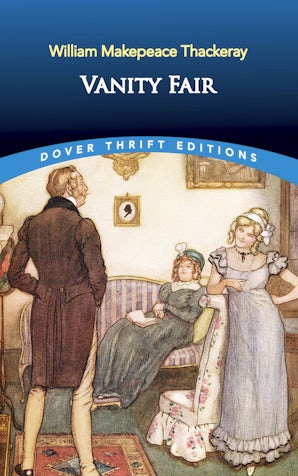
Vanity Fair
Subtitled "a novel without a hero," Vanity Fair offers an acidly satirical romp across all levels of English society during the Napoleonic wars. William Thackeray focuses on how the war affects people other than soldiers, the typical heroes. All of his characters are deeply flawed, from social climber Becky Sharp and sweet Amelia Sedley to caddish George Osborne and loyal William Dobbin. Becky, liar and hypocrite, takes center stage as one of literature's great female protagonists. Penniless, armed with only her beauty, charm, and cunning, she claws her way forward by practicing the corrupt principles of her world. Becky seduces her enemies and betrays friends with a charismatic energy that has captivated generations of readers.
Regarded as Thackeray's best novel and masterpiece, Vanity Fair was published in serial form in 1847–48 in Punch and established the author's literary reputation as well as his social status and financial security. Critic A. E. Dyson acclaimed it as "one of the world's most devious novels, devious in its characterization, its irony, its explicit moralizing, its exuberance, its tone. Few novels demand more continuing alertness from the reader, or offer more intellectual and moral stimulation in return."
Regarded as Thackeray's best novel and masterpiece, Vanity Fair was published in serial form in 1847–48 in Punch and established the author's literary reputation as well as his social status and financial security. Critic A. E. Dyson acclaimed it as "one of the world's most devious novels, devious in its characterization, its irony, its explicit moralizing, its exuberance, its tone. Few novels demand more continuing alertness from the reader, or offer more intellectual and moral stimulation in return."
Reprint of the Oxford University Press, London and New York, 1908 edition.
social satire;social commentary;pretentious people;reputations;shallow people;historical fiction;classics;english society;napoleonic wars;effects of war;british literature;classic literature;power and wealth;literary fiction;english lit;misfortune;adult fiction;humorous;satire;classic fiction;greed;relationships;friendship;nobility;romance;beauty;page turner;lively;dramatic;womens fiction;19th century;money and power;gold digging;deception;book club$3.50
Original: $10.00
-65%Vanity Fair—
$10.00
$3.50Product Information
Product Information
Shipping & Returns
Shipping & Returns
Description
Subtitled "a novel without a hero," Vanity Fair offers an acidly satirical romp across all levels of English society during the Napoleonic wars. William Thackeray focuses on how the war affects people other than soldiers, the typical heroes. All of his characters are deeply flawed, from social climber Becky Sharp and sweet Amelia Sedley to caddish George Osborne and loyal William Dobbin. Becky, liar and hypocrite, takes center stage as one of literature's great female protagonists. Penniless, armed with only her beauty, charm, and cunning, she claws her way forward by practicing the corrupt principles of her world. Becky seduces her enemies and betrays friends with a charismatic energy that has captivated generations of readers.
Regarded as Thackeray's best novel and masterpiece, Vanity Fair was published in serial form in 1847–48 in Punch and established the author's literary reputation as well as his social status and financial security. Critic A. E. Dyson acclaimed it as "one of the world's most devious novels, devious in its characterization, its irony, its explicit moralizing, its exuberance, its tone. Few novels demand more continuing alertness from the reader, or offer more intellectual and moral stimulation in return."
Regarded as Thackeray's best novel and masterpiece, Vanity Fair was published in serial form in 1847–48 in Punch and established the author's literary reputation as well as his social status and financial security. Critic A. E. Dyson acclaimed it as "one of the world's most devious novels, devious in its characterization, its irony, its explicit moralizing, its exuberance, its tone. Few novels demand more continuing alertness from the reader, or offer more intellectual and moral stimulation in return."
Reprint of the Oxford University Press, London and New York, 1908 edition.
social satire;social commentary;pretentious people;reputations;shallow people;historical fiction;classics;english society;napoleonic wars;effects of war;british literature;classic literature;power and wealth;literary fiction;english lit;misfortune;adult fiction;humorous;satire;classic fiction;greed;relationships;friendship;nobility;romance;beauty;page turner;lively;dramatic;womens fiction;19th century;money and power;gold digging;deception;book club