🎉 Up to 70% Off Selected ItemsShop Sale
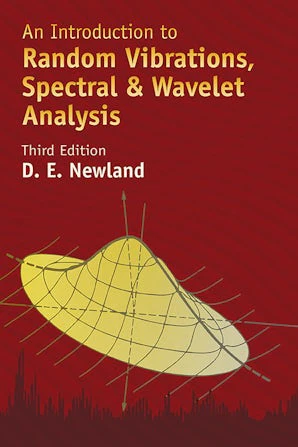
An Introduction to Random Vibrations, Spectral & Wavelet Analysis
One of the first engineering books to cover wavelet analysis, this classic text describes and illustrates basic theory, with a detailed explanation of the workings of discrete wavelet transforms. Computer algorithms are explained and supported by examples and a set of problems, and an appendix lists ten computer programs for calculating and displaying wavelet transforms.
Starting with an introduction to probability distributions and averages, the text examines joint probability distributions, ensemble averages, and correlation; Fourier analysis; spectral density and excitation response relations for linear systems; transmission of random vibration; statistics of narrow band processes; and accuracy of measurements. Discussions of digital spectral analysis cover discrete Fourier transforms as well as windows and smoothing. Additional topics include the fast Fourier transform; pseudo-random processes; multidimensional spectral analysis; response of continuous linear systems to stationary random excitation; and discrete wavelet analysis.
Numerous diagrams and graphs clarify the text, and complicated mathematics are simplified whenever possible. This volume is suitable for upper-level undergraduates and graduate students in engineering and the applied sciences; it is also an important resource for professionals.
Starting with an introduction to probability distributions and averages, the text examines joint probability distributions, ensemble averages, and correlation; Fourier analysis; spectral density and excitation response relations for linear systems; transmission of random vibration; statistics of narrow band processes; and accuracy of measurements. Discussions of digital spectral analysis cover discrete Fourier transforms as well as windows and smoothing. Additional topics include the fast Fourier transform; pseudo-random processes; multidimensional spectral analysis; response of continuous linear systems to stationary random excitation; and discrete wavelet analysis.
Numerous diagrams and graphs clarify the text, and complicated mathematics are simplified whenever possible. This volume is suitable for upper-level undergraduates and graduate students in engineering and the applied sciences; it is also an important resource for professionals.
Unabridged republication of the third edition published by Longman, London, 1993.
$40.00
An Introduction to Random Vibrations, Spectral & Wavelet Analysis—
$40.00
Product Information
Product Information
Shipping & Returns
Shipping & Returns
Description
One of the first engineering books to cover wavelet analysis, this classic text describes and illustrates basic theory, with a detailed explanation of the workings of discrete wavelet transforms. Computer algorithms are explained and supported by examples and a set of problems, and an appendix lists ten computer programs for calculating and displaying wavelet transforms.
Starting with an introduction to probability distributions and averages, the text examines joint probability distributions, ensemble averages, and correlation; Fourier analysis; spectral density and excitation response relations for linear systems; transmission of random vibration; statistics of narrow band processes; and accuracy of measurements. Discussions of digital spectral analysis cover discrete Fourier transforms as well as windows and smoothing. Additional topics include the fast Fourier transform; pseudo-random processes; multidimensional spectral analysis; response of continuous linear systems to stationary random excitation; and discrete wavelet analysis.
Numerous diagrams and graphs clarify the text, and complicated mathematics are simplified whenever possible. This volume is suitable for upper-level undergraduates and graduate students in engineering and the applied sciences; it is also an important resource for professionals.
Starting with an introduction to probability distributions and averages, the text examines joint probability distributions, ensemble averages, and correlation; Fourier analysis; spectral density and excitation response relations for linear systems; transmission of random vibration; statistics of narrow band processes; and accuracy of measurements. Discussions of digital spectral analysis cover discrete Fourier transforms as well as windows and smoothing. Additional topics include the fast Fourier transform; pseudo-random processes; multidimensional spectral analysis; response of continuous linear systems to stationary random excitation; and discrete wavelet analysis.
Numerous diagrams and graphs clarify the text, and complicated mathematics are simplified whenever possible. This volume is suitable for upper-level undergraduates and graduate students in engineering and the applied sciences; it is also an important resource for professionals.
Unabridged republication of the third edition published by Longman, London, 1993.