🎉 Up to 70% Off Selected ItemsShop Sale
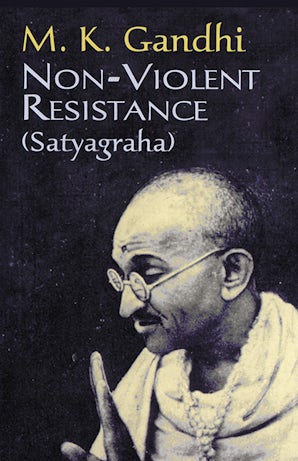
Non-Violent Resistance
Mohandas Gandhi gained the deep respect and admiration of people worldwide with both his unwavering struggle for truth and justice and his philosophy of non-violent resistance — a philosophy that led India to independence and that was later taken up by the American civil rights movement. This volume presents Gandhi's own clear and consistent vision of that philosophy, which he calls Satyagraha — literally, "holding on to the truth." Through Satyagraha, one brings about change by appealing to the reason and conscience of the opponent and puts an end to evil by converting the evil-doer.
The book begins with an introductory explanation of Satyagraha, including a description of how it differs from passive resistance and what it has in common with the civil disobedience of Thoreau and non-cooperation in general. It proceeds with detailed discussions of discipline and self-control, including living simply, recognizing the unity of all loving beings, and serving one's neighbors wholeheartedly; the courage and training necessary for the Satyagrahi; successful on-cooperation and civil disobedience; political power and Satyagraha, the development of a non-violent army; the use and effectiveness of such techniques as non-payment of fines and taxes, social boycotts, fasting, sympathetic strikes, and other forms of non-cooperation; women and picketing; and many other topics.
Invaluable to ethicists, political philosophers, students, and participants in the ongoing struggle for human rights, this inspiring book is as relevant today as it was when first published half a century ago.
The book begins with an introductory explanation of Satyagraha, including a description of how it differs from passive resistance and what it has in common with the civil disobedience of Thoreau and non-cooperation in general. It proceeds with detailed discussions of discipline and self-control, including living simply, recognizing the unity of all loving beings, and serving one's neighbors wholeheartedly; the courage and training necessary for the Satyagrahi; successful on-cooperation and civil disobedience; political power and Satyagraha, the development of a non-violent army; the use and effectiveness of such techniques as non-payment of fines and taxes, social boycotts, fasting, sympathetic strikes, and other forms of non-cooperation; women and picketing; and many other topics.
Invaluable to ethicists, political philosophers, students, and participants in the ongoing struggle for human rights, this inspiring book is as relevant today as it was when first published half a century ago.
Reprint of the Navajvan Trust, Ahmedabad, 1951 edition.
nhat hanh;political prisoners;global security;literary education;political memoirs;mahatma ghandi;freedom movement;civil rights;social revolution;indian independence;mlk jr;bhagavad gita;anti-apartheid movement;african history;global conflicts;political arena;international relations;boer war;blue cloud;political career;market principles;louis fischer;luther kings;einstein's ideas;british government;mandela's story;apartheid government;ghandi's life;oliver tambo;mandela's autobiography;ideas opinions;white minority;president de;british empire;freedom struggle;african national;freedom fighting;spent 27;national congress;self discipline;mandela's life;de klerk;robben island;national party;visited south;truthful account;political awakening;human rights;political animal;nationalist party;human connection;black south;india's independence;nonviolent resistance;apartheid system;village boy;black president;passive resistance;apartheid south;african people;dream speech;white south;political leader;south africans;indian society;super human;freedom fighter;thich nhat;law practice;nelson mandela;civil disobedience;brute force;cape town;albert einstein;humble beginnings;indian culture;social justice;king jr;martin luther;nobel prize;role model;kriya;south africa;strategists;diffusion;northerns;mahatmas;madiba;gujarati;non-cooperation;swaraj;transkei;textbooks;ahimsa;einsteins;booklet;yoga;declaration;satyagraha;toilet;malcolm;mandella;mohandas;interactive;communism;persistent$24.99
Non-Violent Resistance—
$24.99
Product Information
Product Information
Shipping & Returns
Shipping & Returns
Description
Mohandas Gandhi gained the deep respect and admiration of people worldwide with both his unwavering struggle for truth and justice and his philosophy of non-violent resistance — a philosophy that led India to independence and that was later taken up by the American civil rights movement. This volume presents Gandhi's own clear and consistent vision of that philosophy, which he calls Satyagraha — literally, "holding on to the truth." Through Satyagraha, one brings about change by appealing to the reason and conscience of the opponent and puts an end to evil by converting the evil-doer.
The book begins with an introductory explanation of Satyagraha, including a description of how it differs from passive resistance and what it has in common with the civil disobedience of Thoreau and non-cooperation in general. It proceeds with detailed discussions of discipline and self-control, including living simply, recognizing the unity of all loving beings, and serving one's neighbors wholeheartedly; the courage and training necessary for the Satyagrahi; successful on-cooperation and civil disobedience; political power and Satyagraha, the development of a non-violent army; the use and effectiveness of such techniques as non-payment of fines and taxes, social boycotts, fasting, sympathetic strikes, and other forms of non-cooperation; women and picketing; and many other topics.
Invaluable to ethicists, political philosophers, students, and participants in the ongoing struggle for human rights, this inspiring book is as relevant today as it was when first published half a century ago.
The book begins with an introductory explanation of Satyagraha, including a description of how it differs from passive resistance and what it has in common with the civil disobedience of Thoreau and non-cooperation in general. It proceeds with detailed discussions of discipline and self-control, including living simply, recognizing the unity of all loving beings, and serving one's neighbors wholeheartedly; the courage and training necessary for the Satyagrahi; successful on-cooperation and civil disobedience; political power and Satyagraha, the development of a non-violent army; the use and effectiveness of such techniques as non-payment of fines and taxes, social boycotts, fasting, sympathetic strikes, and other forms of non-cooperation; women and picketing; and many other topics.
Invaluable to ethicists, political philosophers, students, and participants in the ongoing struggle for human rights, this inspiring book is as relevant today as it was when first published half a century ago.
Reprint of the Navajvan Trust, Ahmedabad, 1951 edition.
nhat hanh;political prisoners;global security;literary education;political memoirs;mahatma ghandi;freedom movement;civil rights;social revolution;indian independence;mlk jr;bhagavad gita;anti-apartheid movement;african history;global conflicts;political arena;international relations;boer war;blue cloud;political career;market principles;louis fischer;luther kings;einstein's ideas;british government;mandela's story;apartheid government;ghandi's life;oliver tambo;mandela's autobiography;ideas opinions;white minority;president de;british empire;freedom struggle;african national;freedom fighting;spent 27;national congress;self discipline;mandela's life;de klerk;robben island;national party;visited south;truthful account;political awakening;human rights;political animal;nationalist party;human connection;black south;india's independence;nonviolent resistance;apartheid system;village boy;black president;passive resistance;apartheid south;african people;dream speech;white south;political leader;south africans;indian society;super human;freedom fighter;thich nhat;law practice;nelson mandela;civil disobedience;brute force;cape town;albert einstein;humble beginnings;indian culture;social justice;king jr;martin luther;nobel prize;role model;kriya;south africa;strategists;diffusion;northerns;mahatmas;madiba;gujarati;non-cooperation;swaraj;transkei;textbooks;ahimsa;einsteins;booklet;yoga;declaration;satyagraha;toilet;malcolm;mandella;mohandas;interactive;communism;persistent