🎉 Up to 70% Off Selected ItemsShop Sale
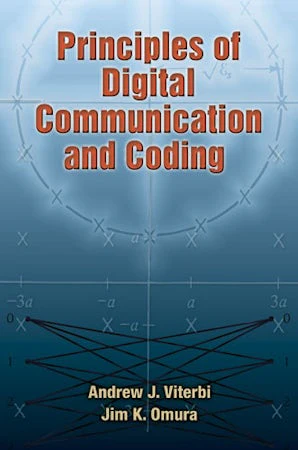
Principles of Digital Communication and Coding
Written by two distinguished experts in the field of digital communications, this classic text remains a vital resource three decades after its initial publication. Its treatment is geared toward advanced students of communications theory and to designers of channels, links, terminals, modems, or networks used to transmit and receive digital messages.
The three-part approach begins with the fundamentals of digital communication and block coding, including an analysis of block code ensemble performance. The second part introduces convolutional coding, exploring ensemble performance and sequential decoding. The final section addresses source coding and rate distortion theory, examining fundamental concepts for memoryless sources as well as precepts related to memory, Gaussian sources, and universal coding. Appendixes of useful information appear throughout the text, and each chapter concludes with a set of problems, the solutions to which are available online.
The three-part approach begins with the fundamentals of digital communication and block coding, including an analysis of block code ensemble performance. The second part introduces convolutional coding, exploring ensemble performance and sequential decoding. The final section addresses source coding and rate distortion theory, examining fundamental concepts for memoryless sources as well as precepts related to memory, Gaussian sources, and universal coding. Appendixes of useful information appear throughout the text, and each chapter concludes with a set of problems, the solutions to which are available online.
Reprint of the McGraw-Hill, New York, 1979 edition.
$10.48
Original: $29.95
-65%Principles of Digital Communication and Coding—
$29.95
$10.48Product Information
Product Information
Shipping & Returns
Shipping & Returns
Description
Written by two distinguished experts in the field of digital communications, this classic text remains a vital resource three decades after its initial publication. Its treatment is geared toward advanced students of communications theory and to designers of channels, links, terminals, modems, or networks used to transmit and receive digital messages.
The three-part approach begins with the fundamentals of digital communication and block coding, including an analysis of block code ensemble performance. The second part introduces convolutional coding, exploring ensemble performance and sequential decoding. The final section addresses source coding and rate distortion theory, examining fundamental concepts for memoryless sources as well as precepts related to memory, Gaussian sources, and universal coding. Appendixes of useful information appear throughout the text, and each chapter concludes with a set of problems, the solutions to which are available online.
The three-part approach begins with the fundamentals of digital communication and block coding, including an analysis of block code ensemble performance. The second part introduces convolutional coding, exploring ensemble performance and sequential decoding. The final section addresses source coding and rate distortion theory, examining fundamental concepts for memoryless sources as well as precepts related to memory, Gaussian sources, and universal coding. Appendixes of useful information appear throughout the text, and each chapter concludes with a set of problems, the solutions to which are available online.
Reprint of the McGraw-Hill, New York, 1979 edition.