🎉 Up to 70% Off Selected ItemsShop Sale
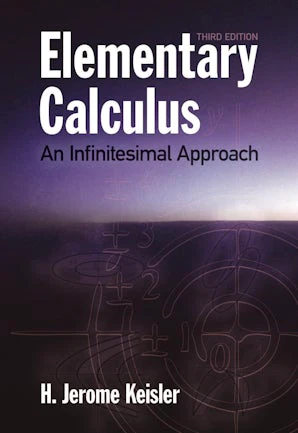
Elementary Calculus
This first-year calculus book is centered around the use of infinitesimals, an approach largely neglected until recently for reasons of mathematical rigor. It exposes students to the intuition that originally led to the calculus, simplifying their grasp of the central concepts of derivatives and integrals. The author also teaches the traditional approach, giving students the benefits of both methods.
Chapters 1 through 4 employ infinitesimals to quickly develop the basic concepts of derivatives, continuity, and integrals. Chapter 5 introduces the traditional limit concept, using approximation problems as the motivation. Later chapters develop transcendental functions, series, vectors, partial derivatives, and multiple integrals. The theory differs from traditional courses, but the notation and methods for solving practical problems are the same. The text suggests a variety of applications to both natural and social sciences.
Chapters 1 through 4 employ infinitesimals to quickly develop the basic concepts of derivatives, continuity, and integrals. Chapter 5 introduces the traditional limit concept, using approximation problems as the motivation. Later chapters develop transcendental functions, series, vectors, partial derivatives, and multiple integrals. The theory differs from traditional courses, but the notation and methods for solving practical problems are the same. The text suggests a variety of applications to both natural and social sciences.
Corrected republication of the Prindle, Weber & Schmidt, 1976, revised in 2000, and updated online in 2007, edition.
calculus; mathematics; elementary calculus; ordinary calculus; basic concepts; textbook; math; central concepts; infinitesimals; derivatives; integrals; traditional approach; methods; continuity; traditional limit concept; approximation problems; motivation; transcendental functions; series; vectors; partial derivatives; multiple integrals; students and teachers; infinitesimals; derivatives; applications of calculus$13.98
Original: $39.95
-65%Elementary Calculus—
$39.95
$13.98Product Information
Product Information
Shipping & Returns
Shipping & Returns
Description
This first-year calculus book is centered around the use of infinitesimals, an approach largely neglected until recently for reasons of mathematical rigor. It exposes students to the intuition that originally led to the calculus, simplifying their grasp of the central concepts of derivatives and integrals. The author also teaches the traditional approach, giving students the benefits of both methods.
Chapters 1 through 4 employ infinitesimals to quickly develop the basic concepts of derivatives, continuity, and integrals. Chapter 5 introduces the traditional limit concept, using approximation problems as the motivation. Later chapters develop transcendental functions, series, vectors, partial derivatives, and multiple integrals. The theory differs from traditional courses, but the notation and methods for solving practical problems are the same. The text suggests a variety of applications to both natural and social sciences.
Chapters 1 through 4 employ infinitesimals to quickly develop the basic concepts of derivatives, continuity, and integrals. Chapter 5 introduces the traditional limit concept, using approximation problems as the motivation. Later chapters develop transcendental functions, series, vectors, partial derivatives, and multiple integrals. The theory differs from traditional courses, but the notation and methods for solving practical problems are the same. The text suggests a variety of applications to both natural and social sciences.
Corrected republication of the Prindle, Weber & Schmidt, 1976, revised in 2000, and updated online in 2007, edition.
calculus; mathematics; elementary calculus; ordinary calculus; basic concepts; textbook; math; central concepts; infinitesimals; derivatives; integrals; traditional approach; methods; continuity; traditional limit concept; approximation problems; motivation; transcendental functions; series; vectors; partial derivatives; multiple integrals; students and teachers; infinitesimals; derivatives; applications of calculus