🎉 Up to 70% Off Selected ItemsShop Sale
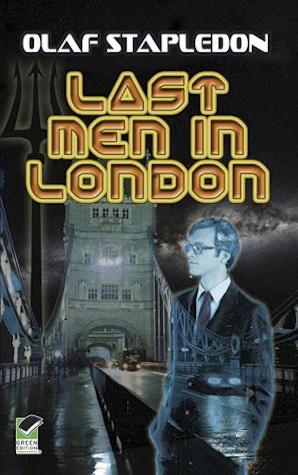
Last Men in London
In his previous science-fiction novel, Last and First Men, Olaf Stapledon envisioned 2 billion years of history, in which modern humans represented the first and most primitive of 18 increasingly advanced species. In this companion piece, a being from the remote future travels back to the 20th century to inhabit the consciousness of an Englishman named Paul. From inside his subject's mind, the superintelligent mega-human observes Paul's childhood, his experiences during World War I, and his postwar life as a teacher. The narrative provides a compelling commentary on modern life, the horrors of warfare, and the disintegrating state of Western society.
British philosopher William Olaf Stapledon (1886–1950) introduced several innovative concepts to the science-fiction genre, and his books influenced Arthur C. Clarke, Brian Aldiss, C. S. Lewis, John Maynard Smith, and many others. In this science-fictional self-portrait, he offers a captivating combination of memory, imagination, and social criticism.
British philosopher William Olaf Stapledon (1886–1950) introduced several innovative concepts to the science-fiction genre, and his books influenced Arthur C. Clarke, Brian Aldiss, C. S. Lewis, John Maynard Smith, and many others. In this science-fictional self-portrait, he offers a captivating combination of memory, imagination, and social criticism.
Reprint of the Methuen & Co. Ltd., London, 1932 edition.
$1.05
Original: $2.99
-65%Last Men in London—
$2.99
$1.05Product Information
Product Information
Shipping & Returns
Shipping & Returns
Description
In his previous science-fiction novel, Last and First Men, Olaf Stapledon envisioned 2 billion years of history, in which modern humans represented the first and most primitive of 18 increasingly advanced species. In this companion piece, a being from the remote future travels back to the 20th century to inhabit the consciousness of an Englishman named Paul. From inside his subject's mind, the superintelligent mega-human observes Paul's childhood, his experiences during World War I, and his postwar life as a teacher. The narrative provides a compelling commentary on modern life, the horrors of warfare, and the disintegrating state of Western society.
British philosopher William Olaf Stapledon (1886–1950) introduced several innovative concepts to the science-fiction genre, and his books influenced Arthur C. Clarke, Brian Aldiss, C. S. Lewis, John Maynard Smith, and many others. In this science-fictional self-portrait, he offers a captivating combination of memory, imagination, and social criticism.
British philosopher William Olaf Stapledon (1886–1950) introduced several innovative concepts to the science-fiction genre, and his books influenced Arthur C. Clarke, Brian Aldiss, C. S. Lewis, John Maynard Smith, and many others. In this science-fictional self-portrait, he offers a captivating combination of memory, imagination, and social criticism.
Reprint of the Methuen & Co. Ltd., London, 1932 edition.