🎉 Up to 70% Off Selected ItemsShop Sale
The Game of Chess
"I have always a slight feeling of pity for the man who has no knowledge of chess, just as I would pity the man who has remained ignorant of love. Chess, like love, like music, has the power to make men happy. The way to this happiness I have tried to show in this book." — Author's Preface
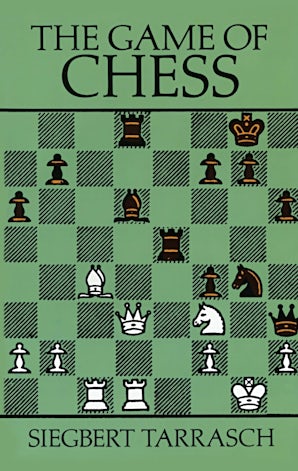
While there are many chess instruction books available, few have achieved the lofty stature of the present volume. Fewer still have been written by a legendary International Grandmaster whose pedagogical skills rivaled the chess prowess that enabled him to demolish opponents at the board. An immediate success upon its first publication, The Game of Chess has become one of the game's enduring classics, considered by some critics the finest book ever written on the game.
Part of its success stems from Dr. Tarrasch's unorthodox approach to teaching chess: "I employ quite another method and one analogous to that a mother uses to teach her child to talk. I play with the beginner from the very start in that I put before him simple positions and from them explain the fundamentals of chess. It is the intuitive method of instruction. In this way the pupil learns chess quite easily, of that I am convinced."
To make it easier for the beginning student, Dr. Tarrasch also reverses the order in which the game is usually taught. Instead, he begins with the End-Game, since "obviously it is easier for the beginner to deal with a few men than the entire thirty-two." Then follows the heart of the book, an important and extensive discussion of the Middle Game. Analyzing the most important parts of hundreds of games, Tarrasch presents a comprehensive treatment of combination play, an aspect of chess for which he was especially renowned. Finally, he deals with the most complex part of the game — the Opening — and offers enlightening comments on many historically important variations.
Illustrated with over 340 diagrams and including 12 complete games, The Game of Chess remains one of the standard texts, a careful reading of which will improve the game of any player.
While there are many chess instruction books available, few have achieved the lofty stature of the present volume. Fewer still have been written by a legendary International Grandmaster whose pedagogical skills rivaled the chess prowess that enabled him to demolish opponents at the board. An immediate success upon its first publication, The Game of Chess has become one of the game's enduring classics, considered by some critics the finest book ever written on the game.
Part of its success stems from Dr. Tarrasch's unorthodox approach to teaching chess: "I employ quite another method and one analogous to that a mother uses to teach her child to talk. I play with the beginner from the very start in that I put before him simple positions and from them explain the fundamentals of chess. It is the intuitive method of instruction. In this way the pupil learns chess quite easily, of that I am convinced."
To make it easier for the beginning student, Dr. Tarrasch also reverses the order in which the game is usually taught. Instead, he begins with the End-Game, since "obviously it is easier for the beginner to deal with a few men than the entire thirty-two." Then follows the heart of the book, an important and extensive discussion of the Middle Game. Analyzing the most important parts of hundreds of games, Tarrasch presents a comprehensive treatment of combination play, an aspect of chess for which he was especially renowned. Finally, he deals with the most complex part of the game — the Opening — and offers enlightening comments on many historically important variations.
Illustrated with over 340 diagrams and including 12 complete games, The Game of Chess remains one of the standard texts, a careful reading of which will improve the game of any player.
Reprint of the David McKay, Philadelphia, 1935 edition.
strategy guides; classic board games; mathematical games; logic games; helpful instructions; pawns; how to guides; algebraic notation; end game plays; game tactics; middle game; openings; game fundamentals; game analysis; playing smart; play combinations; turn based games; game clubs; novice players; bishops; knights; kings; game theories; advanced games; complex; chess strategy;chess skills;chess play;chess teacher;chess theory;chess literature;modern chess;chess move;logical chess;understand chess;chess openings;played chess;chess master;chess games;chess players;chess board;playing chess;play chess;master games;french defense;level players;club player;queen pawn;annotated games;classic games;beginning player;pawn openings;expert level;advanced beginners;ruy lopez;intermediate players;advanced players;middle game;pieces move;single move;queen's gambit;descriptive notation;algebraic notation;logical thinking;grand master;move-by-move;reinfeld;teichmann;colle;capablanca;endgames;middlegame;lasker;uscf;annotates;end-game;positional;kingside;checkmate;nunn;grandmaster;juniors;1200;dover;fundamentals;annotations;instructional;tactical;tournament;instructive;opponent;irving;novice;variations;tactics;strategies;books on chess masters;books on annotated games;books on played chesses;books on middle games;books on chess boards;books on club players;books on expert levels;books on master games;books on chess players;begin player;books on modern chesses;books on chess skills;books on chess theories;books on chess strategies;books on playing chesses;books on advanced beginners;books on chess moves;books on french defenses;books on classic games;books on level players;books on chess games;books on chess literatures;books on chess openings;books on queen pawns;books on chess plays;books on beginning players;books on play chesses$8.73
Original: $24.95
-65%The Game of Chess—
$24.95
$8.73Product Information
Product Information
Shipping & Returns
Shipping & Returns
Description
"I have always a slight feeling of pity for the man who has no knowledge of chess, just as I would pity the man who has remained ignorant of love. Chess, like love, like music, has the power to make men happy. The way to this happiness I have tried to show in this book." — Author's Preface
While there are many chess instruction books available, few have achieved the lofty stature of the present volume. Fewer still have been written by a legendary International Grandmaster whose pedagogical skills rivaled the chess prowess that enabled him to demolish opponents at the board. An immediate success upon its first publication, The Game of Chess has become one of the game's enduring classics, considered by some critics the finest book ever written on the game.
Part of its success stems from Dr. Tarrasch's unorthodox approach to teaching chess: "I employ quite another method and one analogous to that a mother uses to teach her child to talk. I play with the beginner from the very start in that I put before him simple positions and from them explain the fundamentals of chess. It is the intuitive method of instruction. In this way the pupil learns chess quite easily, of that I am convinced."
To make it easier for the beginning student, Dr. Tarrasch also reverses the order in which the game is usually taught. Instead, he begins with the End-Game, since "obviously it is easier for the beginner to deal with a few men than the entire thirty-two." Then follows the heart of the book, an important and extensive discussion of the Middle Game. Analyzing the most important parts of hundreds of games, Tarrasch presents a comprehensive treatment of combination play, an aspect of chess for which he was especially renowned. Finally, he deals with the most complex part of the game — the Opening — and offers enlightening comments on many historically important variations.
Illustrated with over 340 diagrams and including 12 complete games, The Game of Chess remains one of the standard texts, a careful reading of which will improve the game of any player.
While there are many chess instruction books available, few have achieved the lofty stature of the present volume. Fewer still have been written by a legendary International Grandmaster whose pedagogical skills rivaled the chess prowess that enabled him to demolish opponents at the board. An immediate success upon its first publication, The Game of Chess has become one of the game's enduring classics, considered by some critics the finest book ever written on the game.
Part of its success stems from Dr. Tarrasch's unorthodox approach to teaching chess: "I employ quite another method and one analogous to that a mother uses to teach her child to talk. I play with the beginner from the very start in that I put before him simple positions and from them explain the fundamentals of chess. It is the intuitive method of instruction. In this way the pupil learns chess quite easily, of that I am convinced."
To make it easier for the beginning student, Dr. Tarrasch also reverses the order in which the game is usually taught. Instead, he begins with the End-Game, since "obviously it is easier for the beginner to deal with a few men than the entire thirty-two." Then follows the heart of the book, an important and extensive discussion of the Middle Game. Analyzing the most important parts of hundreds of games, Tarrasch presents a comprehensive treatment of combination play, an aspect of chess for which he was especially renowned. Finally, he deals with the most complex part of the game — the Opening — and offers enlightening comments on many historically important variations.
Illustrated with over 340 diagrams and including 12 complete games, The Game of Chess remains one of the standard texts, a careful reading of which will improve the game of any player.
Reprint of the David McKay, Philadelphia, 1935 edition.
strategy guides; classic board games; mathematical games; logic games; helpful instructions; pawns; how to guides; algebraic notation; end game plays; game tactics; middle game; openings; game fundamentals; game analysis; playing smart; play combinations; turn based games; game clubs; novice players; bishops; knights; kings; game theories; advanced games; complex; chess strategy;chess skills;chess play;chess teacher;chess theory;chess literature;modern chess;chess move;logical chess;understand chess;chess openings;played chess;chess master;chess games;chess players;chess board;playing chess;play chess;master games;french defense;level players;club player;queen pawn;annotated games;classic games;beginning player;pawn openings;expert level;advanced beginners;ruy lopez;intermediate players;advanced players;middle game;pieces move;single move;queen's gambit;descriptive notation;algebraic notation;logical thinking;grand master;move-by-move;reinfeld;teichmann;colle;capablanca;endgames;middlegame;lasker;uscf;annotates;end-game;positional;kingside;checkmate;nunn;grandmaster;juniors;1200;dover;fundamentals;annotations;instructional;tactical;tournament;instructive;opponent;irving;novice;variations;tactics;strategies;books on chess masters;books on annotated games;books on played chesses;books on middle games;books on chess boards;books on club players;books on expert levels;books on master games;books on chess players;begin player;books on modern chesses;books on chess skills;books on chess theories;books on chess strategies;books on playing chesses;books on advanced beginners;books on chess moves;books on french defenses;books on classic games;books on level players;books on chess games;books on chess literatures;books on chess openings;books on queen pawns;books on chess plays;books on beginning players;books on play chesses