Point and Line to Plane
"I had the impression that here painting itself comes to the foreground; I wondered if it would not be possible to go further in this direction."
Thus did the young Russian painter Wassily Kandinsky (1866–1944) react to his first viewing of Monet's Haystack, included in an 1895 Moscow exhibit of French Impressionists. It was his first perception of the dematerialization of an object and presaged the later development of his influential theories of non-objective art.
During study and travel in Europe, the young artist breathed the heady atmosphere of artistic experimentation. Fauvism, Cubism, Symbolism, and other movements played an important role in the development of his own revolutionary approach to painting. Decrying literal representation, Kandinsky emphasized instead the importance of form, color, rhythm, and the artist's inner need in expressing reality.
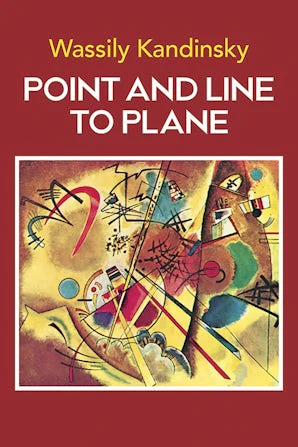
In Point and Line to Plane, one of the most influential books in 20th-century art, Kandinsky presents a detailed exposition of the inner dynamics of non-objective painting. Relying on his own unique terminology, he develops the idea of point as the "proto-element" of painting, the role of point in nature, music, and other art, and the combination of point and line that results in a unique visual language. He then turns to an absorbing discussion of line — the influence of force on line, lyric and dramatic qualities, and the translation of various phenomena into forms of linear expression. With profound artistic insight, Kandinsky points out the organic relationship of the elements of painting, touching on the role of texture, the element of time, and the relationship of all these elements to the basic material plane called upon to receive the content of a work of art.
Originally published in 1926, this essay represents the mature flowering of ideas first expressed in Kandinsky's earlier seminal book, Concerning the Spiritual in Art. As an influential member of the Bauhaus school and a leading theoretician of abstract expressionism, Kandinsky helped formulate the modern artistic temperament. This book amply demonstrates the importance of his contribution and its profound effect on 20th-century art.
Product Information
Product Information
Shipping & Returns
Shipping & Returns
Description
"I had the impression that here painting itself comes to the foreground; I wondered if it would not be possible to go further in this direction."
Thus did the young Russian painter Wassily Kandinsky (1866–1944) react to his first viewing of Monet's Haystack, included in an 1895 Moscow exhibit of French Impressionists. It was his first perception of the dematerialization of an object and presaged the later development of his influential theories of non-objective art.
During study and travel in Europe, the young artist breathed the heady atmosphere of artistic experimentation. Fauvism, Cubism, Symbolism, and other movements played an important role in the development of his own revolutionary approach to painting. Decrying literal representation, Kandinsky emphasized instead the importance of form, color, rhythm, and the artist's inner need in expressing reality.
In Point and Line to Plane, one of the most influential books in 20th-century art, Kandinsky presents a detailed exposition of the inner dynamics of non-objective painting. Relying on his own unique terminology, he develops the idea of point as the "proto-element" of painting, the role of point in nature, music, and other art, and the combination of point and line that results in a unique visual language. He then turns to an absorbing discussion of line — the influence of force on line, lyric and dramatic qualities, and the translation of various phenomena into forms of linear expression. With profound artistic insight, Kandinsky points out the organic relationship of the elements of painting, touching on the role of texture, the element of time, and the relationship of all these elements to the basic material plane called upon to receive the content of a work of art.
Originally published in 1926, this essay represents the mature flowering of ideas first expressed in Kandinsky's earlier seminal book, Concerning the Spiritual in Art. As an influential member of the Bauhaus school and a leading theoretician of abstract expressionism, Kandinsky helped formulate the modern artistic temperament. This book amply demonstrates the importance of his contribution and its profound effect on 20th-century art.