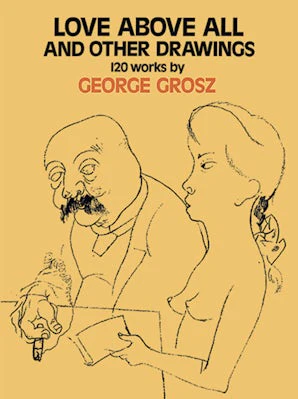
Love Above All and Other Drawings
The locale of these 120 brilliantly satiric drawings is that of Berlin in the 1920s, but a most remarkable thing about them is their startling contemporaneity. We have to keep reminding ourselves that they were not drawn in New York, London, and Paris of the twenty-first century but in the sensation-hungry, inflation-fed milieu of the Weimar Republic.
"On an Expense Account," for example, shows a well-fed businessman and his wife. We see only his back and neck, note her tastelessly modish skirts, and we know the whole story. "Total Devotion from 5:00 to 7:00" is a cocktail-bar scene, and in the dancing of the slick-haired man and the posture of his partner there is something depraved because it is only sensual. "Lunch" depicts a matron with unmistakably porcine features holding knife and fork affectedly as she swills. Her dining partner needs no animalization; the blasé bag below his eye, the expression, and the fold below his chin are enough.
Can prostitutes, contrary to sentimental folklore, appear smug, bloated with satisfaction, and wallowing in cheap gratification? See "Transit Trade" to realize the effects of mindless materialism. Schiller wrote, "Swim if you can and if you are too weak, sink." Grosz takes this as his text for a compelling contrast between rich and poor in just two figures that completely refute the Übermensch doctrine. Hemingway in Nada did not depict more tellingly the utter despair of empty lives in the hour when the café closes than does Grosz in "They Don't Sing Any More." Love Above All? We are only partway through this portfolio when we realize suddenly how bitterly sarcastic is the title.
But the mordant eye, angry wit, and social consciences of Grosz were shared by many of his period. What lifts his art above the transient event is his supremely eloquent use of pen and brush. No one has more expressively, piercingly, and economically, drawn the scenes of his special civilization—so strangely like ours — than did George Grosz.
Original: $10.95
-65%$10.95
$3.83Product Information
Product Information
Shipping & Returns
Shipping & Returns
Description
The locale of these 120 brilliantly satiric drawings is that of Berlin in the 1920s, but a most remarkable thing about them is their startling contemporaneity. We have to keep reminding ourselves that they were not drawn in New York, London, and Paris of the twenty-first century but in the sensation-hungry, inflation-fed milieu of the Weimar Republic.
"On an Expense Account," for example, shows a well-fed businessman and his wife. We see only his back and neck, note her tastelessly modish skirts, and we know the whole story. "Total Devotion from 5:00 to 7:00" is a cocktail-bar scene, and in the dancing of the slick-haired man and the posture of his partner there is something depraved because it is only sensual. "Lunch" depicts a matron with unmistakably porcine features holding knife and fork affectedly as she swills. Her dining partner needs no animalization; the blasé bag below his eye, the expression, and the fold below his chin are enough.
Can prostitutes, contrary to sentimental folklore, appear smug, bloated with satisfaction, and wallowing in cheap gratification? See "Transit Trade" to realize the effects of mindless materialism. Schiller wrote, "Swim if you can and if you are too weak, sink." Grosz takes this as his text for a compelling contrast between rich and poor in just two figures that completely refute the Übermensch doctrine. Hemingway in Nada did not depict more tellingly the utter despair of empty lives in the hour when the café closes than does Grosz in "They Don't Sing Any More." Love Above All? We are only partway through this portfolio when we realize suddenly how bitterly sarcastic is the title.
But the mordant eye, angry wit, and social consciences of Grosz were shared by many of his period. What lifts his art above the transient event is his supremely eloquent use of pen and brush. No one has more expressively, piercingly, and economically, drawn the scenes of his special civilization—so strangely like ours — than did George Grosz.