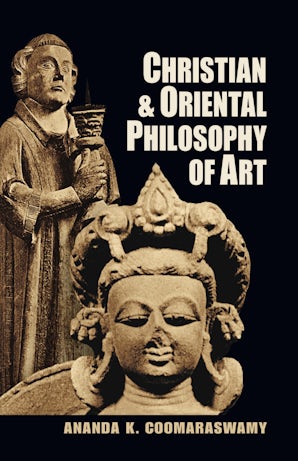
Christian and Oriental Philosophy of Art
The late Ananda K. Coomaraswamy, curator of Indian art at the Boston Museum of Fine Arts, uniquely combined art historian, philosopher, orientalist, linguist, and expositor in his person. His knowledge of the arts and handcrafts of the Orient was unexcelled and his numerous monographs on Oriental art either established or revolutionized entire fields. He was also a great Orientalist, with an almost unmatched understanding of traditional culture. He covered the philosophic and religious experience of the entire premodern world, east and west, and for him primitive, medieval European, and classical Indian experiences of truth and art were only different dialects in a common language.
Finally, Coomaraswamy was a provocative writer, whose erudition was expressed in a delightful, aphoristic style. The nine essays in this book are among his most stimulating. They discuss such matters as the true function of aesthetics in art, the importance of symbolism, and the importance of intellectual and philosophical background to the artists; they demonstrate that abstract art and primitive art, despite superficial resemblances, are completely divergent; and they deal with the common philosophy which pervades all great art, the nature of medieval art, folklore, and modern art, the beauty inherent in mathematics, and the union of traditional symbolism and individual portraiture in premodern cultures.
Product Information
Product Information
Shipping & Returns
Shipping & Returns
Description
The late Ananda K. Coomaraswamy, curator of Indian art at the Boston Museum of Fine Arts, uniquely combined art historian, philosopher, orientalist, linguist, and expositor in his person. His knowledge of the arts and handcrafts of the Orient was unexcelled and his numerous monographs on Oriental art either established or revolutionized entire fields. He was also a great Orientalist, with an almost unmatched understanding of traditional culture. He covered the philosophic and religious experience of the entire premodern world, east and west, and for him primitive, medieval European, and classical Indian experiences of truth and art were only different dialects in a common language.
Finally, Coomaraswamy was a provocative writer, whose erudition was expressed in a delightful, aphoristic style. The nine essays in this book are among his most stimulating. They discuss such matters as the true function of aesthetics in art, the importance of symbolism, and the importance of intellectual and philosophical background to the artists; they demonstrate that abstract art and primitive art, despite superficial resemblances, are completely divergent; and they deal with the common philosophy which pervades all great art, the nature of medieval art, folklore, and modern art, the beauty inherent in mathematics, and the union of traditional symbolism and individual portraiture in premodern cultures.