🎉 Up to 70% Off Selected ItemsShop Sale
HomeStore

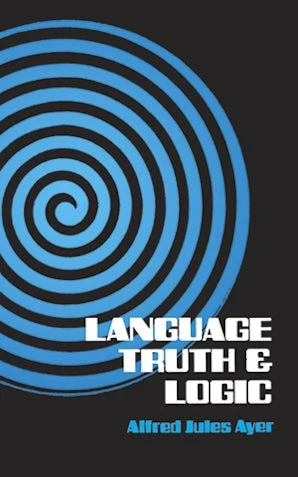
Language, Truth and Logic

Product image 1

Language, Truth and Logic

"A delightful book … I should like to have written it myself." — Bertrand Russell
First published in 1936, this first full-length presentation in English of the Logical Positivism of Carnap, Neurath, and others has gone through many printings to become a classic of thought and communication. It not only surveys one of the most important areas of modern thought; it also shows the confusion that arises from imperfect understanding of the uses of language. A first-rate antidote for fuzzy thought and muddled writing, this remarkable book has helped philosophers, writers, speakers, teachers, students, and general readers alike.
Mr. Ayers sets up specific tests by which you can easily evaluate statements of ideas. You will also learn how to distinguish ideas that cannot be verified by experience — those expressing religious, moral, or aesthetic experience, those expounding theological or metaphysical doctrine, and those dealing with a priori truth. The basic thesis of this work is that philosophy should not squander its energies upon the unknowable, but should perform its proper function in criticism and analysis.
Reprint of the 1936 edition.
classic exposition;tractatus logico-philosophicus;wrong ethical;formal relationship;evidence pertaining;doing philosophy;logical necessity;visual field;transcendent god;empirical investigation;century philosophy;logical positivism;talk nonsense;vienna circle;analytic philosophy;formal logic;moral value;conclusively established;central tenets;empirically verifiable;meaningful statement;everyday language;logical positivists;human understanding;empirical evidence;human knowledge;literal meaning;god exists;raise questions;tautology;ayre;sense-experience;metaphysicians;verifiability;neurath;connexion;empiricists;falsification;verification;falsity;priori;self-contradictory;non-sensical;empiricism;criterion;popper;heidegger;propositions;hume;intelligible;verified;synthetic;kant;metaphysics;disagrees;validity;metaphysical;nonsensical;philosophers;principle;meaningless;ethics;statements;factual;books on formal logics;books on tractatus logico-philosophicus;do philosophy;books on human knowledges;books on metaphysicians;books on verifications;books on century philosophies;books on vienna circles;books on empirical investigations;books on doing philosophies;books on neurath;books on connexions;books on criterions;books on analytic philosophies;books on empirical evidences;books on visual fields;books on everyday languages;books on moral values;books on human understandings;books on hume;books on logical positivisms;books on classic expositions;books on sense-experiences
$4.55

Original: $12.99

-65%
Language, Truth and Logic

$12.99

$4.55

Product Information

Shipping & Returns

Description

"A delightful book … I should like to have written it myself." — Bertrand Russell
First published in 1936, this first full-length presentation in English of the Logical Positivism of Carnap, Neurath, and others has gone through many printings to become a classic of thought and communication. It not only surveys one of the most important areas of modern thought; it also shows the confusion that arises from imperfect understanding of the uses of language. A first-rate antidote for fuzzy thought and muddled writing, this remarkable book has helped philosophers, writers, speakers, teachers, students, and general readers alike.
Mr. Ayers sets up specific tests by which you can easily evaluate statements of ideas. You will also learn how to distinguish ideas that cannot be verified by experience — those expressing religious, moral, or aesthetic experience, those expounding theological or metaphysical doctrine, and those dealing with a priori truth. The basic thesis of this work is that philosophy should not squander its energies upon the unknowable, but should perform its proper function in criticism and analysis.

Reprint of the 1936 edition.
classic exposition;tractatus logico-philosophicus;wrong ethical;formal relationship;evidence pertaining;doing philosophy;logical necessity;visual field;transcendent god;empirical investigation;century philosophy;logical positivism;talk nonsense;vienna circle;analytic philosophy;formal logic;moral value;conclusively established;central tenets;empirically verifiable;meaningful statement;everyday language;logical positivists;human understanding;empirical evidence;human knowledge;literal meaning;god exists;raise questions;tautology;ayre;sense-experience;metaphysicians;verifiability;neurath;connexion;empiricists;falsification;verification;falsity;priori;self-contradictory;non-sensical;empiricism;criterion;popper;heidegger;propositions;hume;intelligible;verified;synthetic;kant;metaphysics;disagrees;validity;metaphysical;nonsensical;philosophers;principle;meaningless;ethics;statements;factual;books on formal logics;books on tractatus logico-philosophicus;do philosophy;books on human knowledges;books on metaphysicians;books on verifications;books on century philosophies;books on vienna circles;books on empirical investigations;books on doing philosophies;books on neurath;books on connexions;books on criterions;books on analytic philosophies;books on empirical evidences;books on visual fields;books on everyday languages;books on moral values;books on human understandings;books on hume;books on logical positivisms;books on classic expositions;books on sense-experiences