🎉 Up to 70% Off Selected ItemsShop Sale
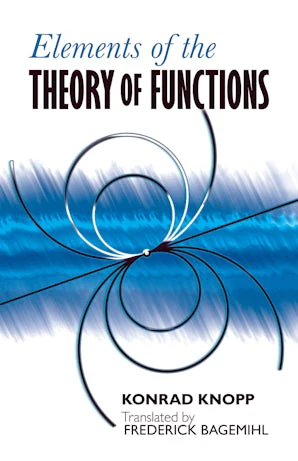
Elements of the Theory of Functions
This well-known book provides a clear and concise review of general function theory via complex variables. Suitable for undergraduate math majors, the treatment explores only those topics that are simplest but are also most important for the development of the theory. Prerequisites include a knowledge of the foundations of real analysis and of the elements of analytic geometry.
The text begins with an introduction to the system of complex numbers and their operations. Then the concept of sets of numbers, the limit concept, and closely related matters are extended to complex quantities. Final chapters examine the elementary functions, including rational and linear functions, exponential and trigonometric functions, and several others as well as their inverses, including the logarithm and the cyclometric functions. Numerous examples clarify the essential ideas, and proofs are expressed in a direct manner without sacrifice of completeness or rigor.
The text begins with an introduction to the system of complex numbers and their operations. Then the concept of sets of numbers, the limit concept, and closely related matters are extended to complex quantities. Final chapters examine the elementary functions, including rational and linear functions, exponential and trigonometric functions, and several others as well as their inverses, including the logarithm and the cyclometric functions. Numerous examples clarify the essential ideas, and proofs are expressed in a direct manner without sacrifice of completeness or rigor.
Reprint of the Dover 1952 edition.
$3.83
Original: $10.95
-65%Elements of the Theory of Functions—
$10.95
$3.83Product Information
Product Information
Shipping & Returns
Shipping & Returns
Description
This well-known book provides a clear and concise review of general function theory via complex variables. Suitable for undergraduate math majors, the treatment explores only those topics that are simplest but are also most important for the development of the theory. Prerequisites include a knowledge of the foundations of real analysis and of the elements of analytic geometry.
The text begins with an introduction to the system of complex numbers and their operations. Then the concept of sets of numbers, the limit concept, and closely related matters are extended to complex quantities. Final chapters examine the elementary functions, including rational and linear functions, exponential and trigonometric functions, and several others as well as their inverses, including the logarithm and the cyclometric functions. Numerous examples clarify the essential ideas, and proofs are expressed in a direct manner without sacrifice of completeness or rigor.
The text begins with an introduction to the system of complex numbers and their operations. Then the concept of sets of numbers, the limit concept, and closely related matters are extended to complex quantities. Final chapters examine the elementary functions, including rational and linear functions, exponential and trigonometric functions, and several others as well as their inverses, including the logarithm and the cyclometric functions. Numerous examples clarify the essential ideas, and proofs are expressed in a direct manner without sacrifice of completeness or rigor.
Reprint of the Dover 1952 edition.