🎉 Up to 70% Off Selected ItemsShop Sale
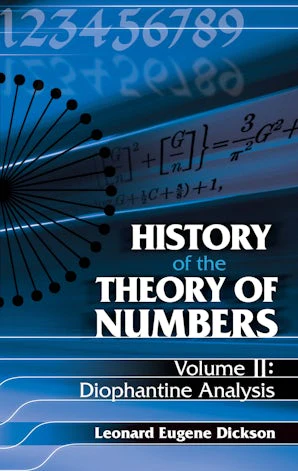
History of the Theory of Numbers, Volume II
The three-volume series History of the Theory of Numbers is the work of the distinguished mathematician Leonard Eugene Dickson, who taught at the University of Chicago for four decades and is celebrated for his many contributions to number theory and group theory. This second volume in the series, which is suitable for upper-level undergraduates and graduate students, is devoted to the subject of diophantine analysis. It can be read independently of the preceding volume, which explores divisibility and primality, and volume III, which examines quadratic and higher forms.
Featured topics include polygonal, pyramidal, and figurate numbers; linear diophantine equations and congruences; partitions; rational right triangles; triangles, quadrilaterals, and tetrahedra; the sums of two, three, four, and n squares; the number of solutions of quadratic congruences in n unknowns; Liouville's series of eighteen articles; the Pell equation; squares in arithmetical or geometrical progression; equations of degrees three, four, and n; sets of integers with equal sums of like powers; Waring's problem and related results; Fermat's last theorem; and many other related subjects. Indexes of authors cited and subjects appear at the end of the book.
Featured topics include polygonal, pyramidal, and figurate numbers; linear diophantine equations and congruences; partitions; rational right triangles; triangles, quadrilaterals, and tetrahedra; the sums of two, three, four, and n squares; the number of solutions of quadratic congruences in n unknowns; Liouville's series of eighteen articles; the Pell equation; squares in arithmetical or geometrical progression; equations of degrees three, four, and n; sets of integers with equal sums of like powers; Waring's problem and related results; Fermat's last theorem; and many other related subjects. Indexes of authors cited and subjects appear at the end of the book.
Unabridged republication of the edition published by Carnegie Institution, Washington, DC, 1919.
$11.20
Original: $31.99
-65%History of the Theory of Numbers, Volume II—
$31.99
$11.20Product Information
Product Information
Shipping & Returns
Shipping & Returns
Description
The three-volume series History of the Theory of Numbers is the work of the distinguished mathematician Leonard Eugene Dickson, who taught at the University of Chicago for four decades and is celebrated for his many contributions to number theory and group theory. This second volume in the series, which is suitable for upper-level undergraduates and graduate students, is devoted to the subject of diophantine analysis. It can be read independently of the preceding volume, which explores divisibility and primality, and volume III, which examines quadratic and higher forms.
Featured topics include polygonal, pyramidal, and figurate numbers; linear diophantine equations and congruences; partitions; rational right triangles; triangles, quadrilaterals, and tetrahedra; the sums of two, three, four, and n squares; the number of solutions of quadratic congruences in n unknowns; Liouville's series of eighteen articles; the Pell equation; squares in arithmetical or geometrical progression; equations of degrees three, four, and n; sets of integers with equal sums of like powers; Waring's problem and related results; Fermat's last theorem; and many other related subjects. Indexes of authors cited and subjects appear at the end of the book.
Featured topics include polygonal, pyramidal, and figurate numbers; linear diophantine equations and congruences; partitions; rational right triangles; triangles, quadrilaterals, and tetrahedra; the sums of two, three, four, and n squares; the number of solutions of quadratic congruences in n unknowns; Liouville's series of eighteen articles; the Pell equation; squares in arithmetical or geometrical progression; equations of degrees three, four, and n; sets of integers with equal sums of like powers; Waring's problem and related results; Fermat's last theorem; and many other related subjects. Indexes of authors cited and subjects appear at the end of the book.
Unabridged republication of the edition published by Carnegie Institution, Washington, DC, 1919.