🎉 Up to 70% Off Selected ItemsShop Sale
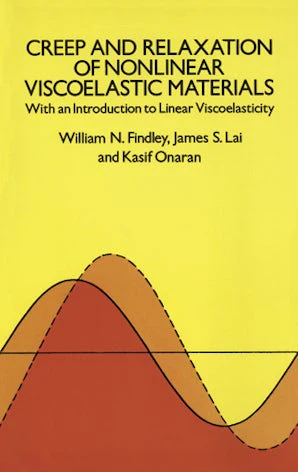
Creep and Relaxation of Nonlinear Viscoelastic Materials
This pioneering book presents the basic theory, experimental methods, experimental results and solution of boundary value problems in a readable, useful way to designers as well as research workers and students. The mathematical background required has been kept to a minimum and supplemented by explanations where it has been necessary to introduce specialized mathematics. Also, appendices have been included to provide sufficient background in Laplace transforms and in step functions.
Chapters 1 and 2 contain an introduction and historic review of creep. As an aid to the reader a background on stress, strain, and stress analysis is provided in Chapters 3 and 4, an introduction to linear viscoelasticity is found in Chapter 5 and linear viscoelastic stress analysis in Chapter 6. In the next six chapters the multiple integral representation of nonlinear creep and relaxation, and simplifications to single integral forms and incompressibility, are examined at length. After a consideration of other representations, general relations are derived, then expanded to components of stress or strain for special cases. Both constant stress (or strain) and variable states are described, together with methods of determining material constants. Conversion from creep to relaxation, effects of temperature and stress analysis problems in nonlinear materials are also treated here.
Finally, Chapter 13 discusses experimental methods for creep and stress relaxation under combined stress. This chapter considers especially those experimental problems which must be solved properly when reliable experimental results of high precision are required. Six appendices present the necessary mathematical background, conversion tables, and more rigorous derivations than employed in the text. An extensive updated bibliography completes the book.
Chapters 1 and 2 contain an introduction and historic review of creep. As an aid to the reader a background on stress, strain, and stress analysis is provided in Chapters 3 and 4, an introduction to linear viscoelasticity is found in Chapter 5 and linear viscoelastic stress analysis in Chapter 6. In the next six chapters the multiple integral representation of nonlinear creep and relaxation, and simplifications to single integral forms and incompressibility, are examined at length. After a consideration of other representations, general relations are derived, then expanded to components of stress or strain for special cases. Both constant stress (or strain) and variable states are described, together with methods of determining material constants. Conversion from creep to relaxation, effects of temperature and stress analysis problems in nonlinear materials are also treated here.
Finally, Chapter 13 discusses experimental methods for creep and stress relaxation under combined stress. This chapter considers especially those experimental problems which must be solved properly when reliable experimental results of high precision are required. Six appendices present the necessary mathematical background, conversion tables, and more rigorous derivations than employed in the text. An extensive updated bibliography completes the book.
Reprint of the North-Holland Publishing Company, Amsterdam, Holland, 1976 edition.
mechanical engineering; civil engineering; environmental engineering; science; math; physics; viscoelasticity; stress; technology; nanoscience; geomechanics; numerical models; basic theory; experimental methods; experimental results; boundary value problems; linear viscoelasticity; creep and relaxation; non-linear creep and relaxation; deformation analysis; stress and strain; creep; elasticity$10.48
Original: $29.95
-65%Creep and Relaxation of Nonlinear Viscoelastic Materials—
$29.95
$10.48Product Information
Product Information
Shipping & Returns
Shipping & Returns
Description
This pioneering book presents the basic theory, experimental methods, experimental results and solution of boundary value problems in a readable, useful way to designers as well as research workers and students. The mathematical background required has been kept to a minimum and supplemented by explanations where it has been necessary to introduce specialized mathematics. Also, appendices have been included to provide sufficient background in Laplace transforms and in step functions.
Chapters 1 and 2 contain an introduction and historic review of creep. As an aid to the reader a background on stress, strain, and stress analysis is provided in Chapters 3 and 4, an introduction to linear viscoelasticity is found in Chapter 5 and linear viscoelastic stress analysis in Chapter 6. In the next six chapters the multiple integral representation of nonlinear creep and relaxation, and simplifications to single integral forms and incompressibility, are examined at length. After a consideration of other representations, general relations are derived, then expanded to components of stress or strain for special cases. Both constant stress (or strain) and variable states are described, together with methods of determining material constants. Conversion from creep to relaxation, effects of temperature and stress analysis problems in nonlinear materials are also treated here.
Finally, Chapter 13 discusses experimental methods for creep and stress relaxation under combined stress. This chapter considers especially those experimental problems which must be solved properly when reliable experimental results of high precision are required. Six appendices present the necessary mathematical background, conversion tables, and more rigorous derivations than employed in the text. An extensive updated bibliography completes the book.
Chapters 1 and 2 contain an introduction and historic review of creep. As an aid to the reader a background on stress, strain, and stress analysis is provided in Chapters 3 and 4, an introduction to linear viscoelasticity is found in Chapter 5 and linear viscoelastic stress analysis in Chapter 6. In the next six chapters the multiple integral representation of nonlinear creep and relaxation, and simplifications to single integral forms and incompressibility, are examined at length. After a consideration of other representations, general relations are derived, then expanded to components of stress or strain for special cases. Both constant stress (or strain) and variable states are described, together with methods of determining material constants. Conversion from creep to relaxation, effects of temperature and stress analysis problems in nonlinear materials are also treated here.
Finally, Chapter 13 discusses experimental methods for creep and stress relaxation under combined stress. This chapter considers especially those experimental problems which must be solved properly when reliable experimental results of high precision are required. Six appendices present the necessary mathematical background, conversion tables, and more rigorous derivations than employed in the text. An extensive updated bibliography completes the book.
Reprint of the North-Holland Publishing Company, Amsterdam, Holland, 1976 edition.
mechanical engineering; civil engineering; environmental engineering; science; math; physics; viscoelasticity; stress; technology; nanoscience; geomechanics; numerical models; basic theory; experimental methods; experimental results; boundary value problems; linear viscoelasticity; creep and relaxation; non-linear creep and relaxation; deformation analysis; stress and strain; creep; elasticity