🎉 Up to 70% Off Selected ItemsShop Sale
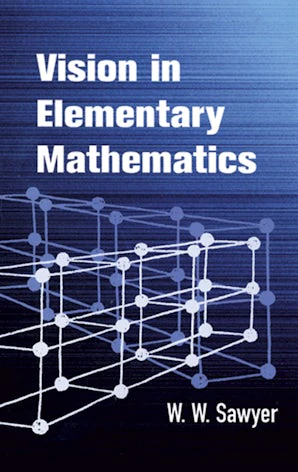
Vision in Elementary Mathematics
Here is a presentation of elementary mathematics that anyone can appreciate, especially those with imagination. As the title suggests, the author's technique relies on visual elements, and his approach employs the most graphic and least "forbidding" aspects of mathematics. Most people, he observes, possess a direct vision that permits them to "see" only the smaller numbers; with the larger numbers, however, vision fails and mental chaos ensues.
Sawyer addresses this difficulty, speaking both for those who like recreational mathematics and for those who teach, suggesting a variety of methods used by many effective teachers — techniques of visualizing, dramatizing, and analyzing numbers that attract and retain the attention and understanding of students. His topics, ranging from basic multiplication and division to algebra, encompass word problems, graphs, negative numbers, fractions, and many other practical applications of elementary mathematics.
A valuable resource for parents and teachers, this book will captivate any reader seeking an improved understanding of mathematics.
Sawyer addresses this difficulty, speaking both for those who like recreational mathematics and for those who teach, suggesting a variety of methods used by many effective teachers — techniques of visualizing, dramatizing, and analyzing numbers that attract and retain the attention and understanding of students. His topics, ranging from basic multiplication and division to algebra, encompass word problems, graphs, negative numbers, fractions, and many other practical applications of elementary mathematics.
A valuable resource for parents and teachers, this book will captivate any reader seeking an improved understanding of mathematics.
Reprint of the Penguin Books, Ltd., England, 1964 edition.
math education; mathematics; basic math; resource; arithmetic; student math; visual elements; understanding; concept of large numbers; algebra; recreational math; practical applications; fractions; multiplication; word problems; textbook; improved understanding; elementary school; divisibility tests; mistakes; avoiding mistakes; problem solving; division; algebra; graphs; fractions$10.48
Original: $29.95
-65%Vision in Elementary Mathematics—
$29.95
$10.48Product Information
Product Information
Shipping & Returns
Shipping & Returns
Description
Here is a presentation of elementary mathematics that anyone can appreciate, especially those with imagination. As the title suggests, the author's technique relies on visual elements, and his approach employs the most graphic and least "forbidding" aspects of mathematics. Most people, he observes, possess a direct vision that permits them to "see" only the smaller numbers; with the larger numbers, however, vision fails and mental chaos ensues.
Sawyer addresses this difficulty, speaking both for those who like recreational mathematics and for those who teach, suggesting a variety of methods used by many effective teachers — techniques of visualizing, dramatizing, and analyzing numbers that attract and retain the attention and understanding of students. His topics, ranging from basic multiplication and division to algebra, encompass word problems, graphs, negative numbers, fractions, and many other practical applications of elementary mathematics.
A valuable resource for parents and teachers, this book will captivate any reader seeking an improved understanding of mathematics.
Sawyer addresses this difficulty, speaking both for those who like recreational mathematics and for those who teach, suggesting a variety of methods used by many effective teachers — techniques of visualizing, dramatizing, and analyzing numbers that attract and retain the attention and understanding of students. His topics, ranging from basic multiplication and division to algebra, encompass word problems, graphs, negative numbers, fractions, and many other practical applications of elementary mathematics.
A valuable resource for parents and teachers, this book will captivate any reader seeking an improved understanding of mathematics.
Reprint of the Penguin Books, Ltd., England, 1964 edition.
math education; mathematics; basic math; resource; arithmetic; student math; visual elements; understanding; concept of large numbers; algebra; recreational math; practical applications; fractions; multiplication; word problems; textbook; improved understanding; elementary school; divisibility tests; mistakes; avoiding mistakes; problem solving; division; algebra; graphs; fractions