🎉 Up to 70% Off Selected ItemsShop Sale
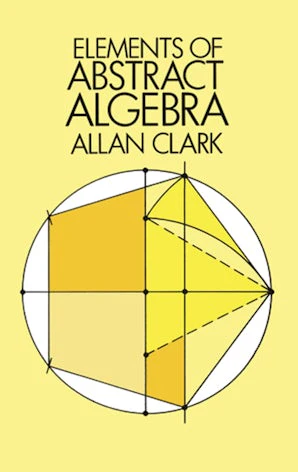
Elements of Abstract Algebra
This concise, readable, college-level text treats basic abstract algebra in remarkable depth and detail. An antidote to the usual surveys of structure, the book presents group theory, Galois theory, and classical ideal theory in a framework emphasizing proof of important theorems.
Chapter I (Set Theory) covers the basics of sets. Chapter II (Group Theory) is a rigorous introduction to groups. It contains all the results needed for Galois theory as well as the Sylow theorems, the Jordan-Holder theorem, and a complete treatment of the simplicity of alternating groups. Chapter III (Field Theory) reviews linear algebra and introduces fields as a prelude to Galois theory. In addition there is a full discussion of the constructibility of regular polygons. Chapter IV (Galois Theory) gives a thorough treatment of this classical topic, including a detailed presentation of the solvability of equations in radicals that actually includes solutions of equations of degree 3 and 4 ― a feature omitted from all texts of the last 40 years. Chapter V (Ring Theory) contains basic information about rings and unique factorization to set the stage for classical ideal theory. Chapter VI (Classical Ideal Theory) ends with an elementary proof of the Fundamental Theorem of Algebraic Number Theory for the special case of Galois extensions of the rational field, a result which brings together all the major themes of the book.
The writing is clear and careful throughout, and includes many historical notes. Mathematical proof is emphasized. The text comprises 198 articles ranging in length from a paragraph to a page or two, pitched at a level that encourages careful reading. Most articles are accompanied by exercises, varying in level from the simple to the difficult.
Chapter I (Set Theory) covers the basics of sets. Chapter II (Group Theory) is a rigorous introduction to groups. It contains all the results needed for Galois theory as well as the Sylow theorems, the Jordan-Holder theorem, and a complete treatment of the simplicity of alternating groups. Chapter III (Field Theory) reviews linear algebra and introduces fields as a prelude to Galois theory. In addition there is a full discussion of the constructibility of regular polygons. Chapter IV (Galois Theory) gives a thorough treatment of this classical topic, including a detailed presentation of the solvability of equations in radicals that actually includes solutions of equations of degree 3 and 4 ― a feature omitted from all texts of the last 40 years. Chapter V (Ring Theory) contains basic information about rings and unique factorization to set the stage for classical ideal theory. Chapter VI (Classical Ideal Theory) ends with an elementary proof of the Fundamental Theorem of Algebraic Number Theory for the special case of Galois extensions of the rational field, a result which brings together all the major themes of the book.
The writing is clear and careful throughout, and includes many historical notes. Mathematical proof is emphasized. The text comprises 198 articles ranging in length from a paragraph to a page or two, pitched at a level that encourages careful reading. Most articles are accompanied by exercises, varying in level from the simple to the difficult.
Reprint of the Wadsworth Publishing Company, Belmont, California, 1971 edition.
$4.53
Original: $12.95
-65%Elements of Abstract Algebra—
$12.95
$4.53Product Information
Product Information
Shipping & Returns
Shipping & Returns
Description
This concise, readable, college-level text treats basic abstract algebra in remarkable depth and detail. An antidote to the usual surveys of structure, the book presents group theory, Galois theory, and classical ideal theory in a framework emphasizing proof of important theorems.
Chapter I (Set Theory) covers the basics of sets. Chapter II (Group Theory) is a rigorous introduction to groups. It contains all the results needed for Galois theory as well as the Sylow theorems, the Jordan-Holder theorem, and a complete treatment of the simplicity of alternating groups. Chapter III (Field Theory) reviews linear algebra and introduces fields as a prelude to Galois theory. In addition there is a full discussion of the constructibility of regular polygons. Chapter IV (Galois Theory) gives a thorough treatment of this classical topic, including a detailed presentation of the solvability of equations in radicals that actually includes solutions of equations of degree 3 and 4 ― a feature omitted from all texts of the last 40 years. Chapter V (Ring Theory) contains basic information about rings and unique factorization to set the stage for classical ideal theory. Chapter VI (Classical Ideal Theory) ends with an elementary proof of the Fundamental Theorem of Algebraic Number Theory for the special case of Galois extensions of the rational field, a result which brings together all the major themes of the book.
The writing is clear and careful throughout, and includes many historical notes. Mathematical proof is emphasized. The text comprises 198 articles ranging in length from a paragraph to a page or two, pitched at a level that encourages careful reading. Most articles are accompanied by exercises, varying in level from the simple to the difficult.
Chapter I (Set Theory) covers the basics of sets. Chapter II (Group Theory) is a rigorous introduction to groups. It contains all the results needed for Galois theory as well as the Sylow theorems, the Jordan-Holder theorem, and a complete treatment of the simplicity of alternating groups. Chapter III (Field Theory) reviews linear algebra and introduces fields as a prelude to Galois theory. In addition there is a full discussion of the constructibility of regular polygons. Chapter IV (Galois Theory) gives a thorough treatment of this classical topic, including a detailed presentation of the solvability of equations in radicals that actually includes solutions of equations of degree 3 and 4 ― a feature omitted from all texts of the last 40 years. Chapter V (Ring Theory) contains basic information about rings and unique factorization to set the stage for classical ideal theory. Chapter VI (Classical Ideal Theory) ends with an elementary proof of the Fundamental Theorem of Algebraic Number Theory for the special case of Galois extensions of the rational field, a result which brings together all the major themes of the book.
The writing is clear and careful throughout, and includes many historical notes. Mathematical proof is emphasized. The text comprises 198 articles ranging in length from a paragraph to a page or two, pitched at a level that encourages careful reading. Most articles are accompanied by exercises, varying in level from the simple to the difficult.
Reprint of the Wadsworth Publishing Company, Belmont, California, 1971 edition.