Introduction to Modern Optics
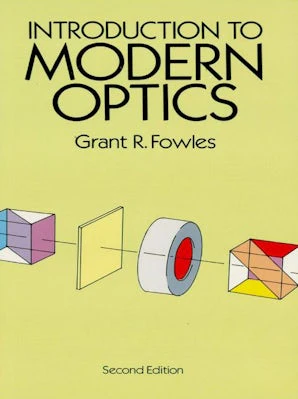
This incisive text provides a basic undergraduate-level course in modern optics for students in physics, technology and engineering. The first half of the book deals with classical physical optics; the second principally with the quantum nature of light. Chapters 1 and 2 treat the propagation of light waves, including the concepts of phase and group velocities, and the vectorial nature of light. Chapter 3 applies the concepts of partial coherence and coherence length to the study of interference, and Chapter 4 takes up multiple-beam interference and includes Fabry-Perot interferometry and multilayer-film theory. Diffraction and holography are the subjects of Chapter 5, and the propagation of light in material media (including crystal and nonlinear optics) are central to Chapter 6. Chapters 7 and 8 introduce the quantum theory of light and elementary optical spectra, and Chapter 9 explores the theory of light amplification and lasers. Chapter 10 briefly outlines ray optics in order to introduce students to the matrix method for treating optical systems and to apply the ray matrix to the study of laser resonators.
Many applications of the laser to the study of optics are integrated throughout the text. The author assumes students have had an intermediate course in electricity and magnetism and some advanced mathematics beyond calculus. For classroom use, a list of problems is included at the end of each chapter, with selected answers at the end of the book.
Original: $18.95
-65%$18.95
$6.63Product Information
Product Information
Shipping & Returns
Shipping & Returns
Description
This incisive text provides a basic undergraduate-level course in modern optics for students in physics, technology and engineering. The first half of the book deals with classical physical optics; the second principally with the quantum nature of light. Chapters 1 and 2 treat the propagation of light waves, including the concepts of phase and group velocities, and the vectorial nature of light. Chapter 3 applies the concepts of partial coherence and coherence length to the study of interference, and Chapter 4 takes up multiple-beam interference and includes Fabry-Perot interferometry and multilayer-film theory. Diffraction and holography are the subjects of Chapter 5, and the propagation of light in material media (including crystal and nonlinear optics) are central to Chapter 6. Chapters 7 and 8 introduce the quantum theory of light and elementary optical spectra, and Chapter 9 explores the theory of light amplification and lasers. Chapter 10 briefly outlines ray optics in order to introduce students to the matrix method for treating optical systems and to apply the ray matrix to the study of laser resonators.
Many applications of the laser to the study of optics are integrated throughout the text. The author assumes students have had an intermediate course in electricity and magnetism and some advanced mathematics beyond calculus. For classroom use, a list of problems is included at the end of each chapter, with selected answers at the end of the book.